- Thursday, 19 February 2026
Chitwan, Feb 18: Nepal Layers Association has increased the price of egg to be effective from today.
Accordingly, the price of big egg is Rs 425 per crate while that of the medium size egg is Rs 375 per crate.
The Association stated that the price of egg has been increased as the production cost has gone up. The production cost is Rs 19.12 per unit egg.
—
09- Slight decline in gold, silver prices
Kathmandu, Feb 18: The price of gold and silver has slightly decreased in the domestic market today.
The price of gold has declined by Rs 1,500 per tola (11.66 grammes) while that of silver by Rs 5 per tola today as compared to Tuesday.
According to the Federation of Nepal Gold and Silver Dealers’ Association, gold is being traded at Rs 300,400 per tola and silver at Rs 4,880 per tola.
The price of the yellow metal was 301,900 per tola and that of silver Rs 4,885 per tola on Tuesday.
According to the international media, gold is being traded at 4920 US dollar per ounce and silver at 75 US dollar per ounce in the international market today.
—
10- Thirteen concrete, 17 suspension bridges built in Bhojpur since 2015
Bhojpur, Feb 18: A total of 13 concrete bridges and 17 suspension bridges have been built in Bhojpur district following the implementation of federalism in 2015.
The Koshi Province government constructed these infrastructures across the district with substantial investment aiming to improve transportation service and enhance access to essential services for local residents.
According to Rajanraj Reddy, Chief of Infrastructure Development Office, a concrete bridge over the Pikhuwa River was built at the cost of Rs 75 million, while bridges over the Aari River and the Behere River have been constructed at the cost of Rs 30 million and Rs 35 million respectively.
Reddy further shared that similar bridges were completed over the Khalde Pikhuwa River and Raute River with the investment of Rs 25 million and Rs 35 million respectively.
Likewise, concrete bridges were made over the Kawa River and the Shyama River at Rs 75 million and Rs 34.2 million respectively, informed Reddy.
Concrete bridges were also developed over the Bangkhuwa River at the cost of Rs 22.5 million, over the Gankhuwa River at Rs 45 million, over the Siktel River at Rs 40 million, over the Ekhuwa River at Rs 66 million and over the Chirkhuwa River at Rs 56.3 million.
Another concrete bridge at Tamutarmaru, being built at the investment of Rs 63.5 million, is nearing completion, he added.
—
11- Annapurna Rural Municipality supplies oranges worth around Rs 40 million this year
Myagdi, Feb 18: Farmers in Annapurna Rural Municipality supplied oranges worth around Rs 40 million this year, according to data collected by the Agricultural Development Section of the rural municipality.
Section technician Samjhana Khatri said the municipality supplied oranges worth Rs 38.8 million this year. All seven wards contributed to the sales, with each ward supplying oranges valued between Rs 1 million and Rs 18.8 million.
More than 200 farmers sold oranges ranging from a minimum of Rs 50,000 to as much as Rs 2 million. The highest sales were recorded by Bikash Shrestha of Dosalle in Ward-7.
Although orange production declined by 40 percent this year, farmers received nearly double the price compared to last year, with oranges fetching up to Rs 200 per kilogram.
Orange is a major cash crop of Annapurna Rural Municipality, which is also well known for potato production.
Rural municipality Vice-Chair Diwa Tilija Pun said the local government has been supporting farmers in expanding and managing orange orchards.
—
12- Aditya Dhwaj Joshi Memorial Award goes to Sharma and Onta
Kathmandu, Feb 18: The Aditya Dhwaj Joshi Memorial Award is to be conferred on Dilip Sharma, Sub Editor of the RSS International News Section, and photojournalist Pradeep Raj Onta this year.
The Award presented annually by the Nepal National Employees’ Organisation, RSS branch on the occasion of the anniversary of , the National News Agency.
Organisation Chairperson Prem Prasad Upadhyay said that it has been decided to present the Award to Sharma and Onta this year on the occasion of RSS’s 65th anniversary.
The Award instituted in honour of former RSS Administrator Joshi, carries a purse of Rs 7,500 per person and it is given to two employees each year.
The RSS began its news service from the house of former administrator Joshi, a resident of New Road, Kathmandu, on the 7th of Falgun, 2018 BS. The Organisation established the award in 2066 BS to his memory.
Previously, Raju Shakya and Phiruram Chaudhary (2067), Dhruba Bhakta Shrestha and Balbahadur Bishwakarma (2068), Madan Gautam and Shambhu Prasad Yadav (2069), Ramesh Mishra and Pabitra Gurung (2070), Krishna Prasad Sharma and Bholanath Paudel (2071), Rambhagat Budhathoki and Mangal Bahadur Jalahari (2072), as well as Nhuchheraj Bajracharya and Sagur Singh Rana (2073) have been awarded this prize.
Similarly, other recipients of this Award are Jagat Krishna Shrestha and Rajani Bajracharya (2074), Tirtha Prasad Bhattarai and Ramlal Shrestha (2075), Bishnu Prasad Lamichhane and Hari Banstola (2076), Deep Raj Sanyal and Rajesh Kumar Shrestha (2077), Madhusudan Aryal and Bishnu Bahadur Thapa (2078), Uttam Silwal and Reshma Shakya (2079), Ram Bahadur Thapa and Rajinan Sah (2080) and Manoj Karki and Ratna Krishna Shrestha (2081).
—
13- HoR polls: Candidates in Myagdi identify need to implement Myagdi as mountainous district as major election agenda
Myagdi, Feb 18: Candidates contesting from Myagdi in the 2026 House of Representatives (HoR) election have recognised the need to make a policy intervention to ensure the implementation of the government’s declaration recognizing Myagdi as a mountainous district their main election agenda.
Although the government officially listed Myagdi as a ‘mountainous district’ seven years ago by amending some Acts of Nepal, the declaration has yet to be fully implemented in the absence the amendment of relevant laws.
On March 3, 2019, the government published a notice in the Nepal Gazette designating Myagdi as the country’s 21st mountainous district. However, due to the lack of implementation, the district, its projects, and local levels have been unable to access budgets and grants allocated for mountainous districts. Teachers and government employees have also been deprived of the additional facilities and benefits provided to staff serving in mountain districts.
Recognizing these challenges, election candidates have emphasized the urgent need to enforce the declaration.
Nepali Congress candidate Karna Bahadur Bhandari said that, alongside implementing the mountainous district status, improving public service delivery in Myagdi is equally important.
Similarly, a CPN (UML) candidate Hari Krishna Shrestha said that failure to implement the declaration has negatively affected development efforts and public service delivery in the district.
Nepali Communist Party candidate Arjun Thapa added that delays in development projects and the reluctance of employees to work in the district are also consequences of the government’s failure to enforce the announcement.
Likewise, independent candidate Mahabir Pun emphasized the implementation of criteria recognizing Myagdi as a mountainous district, stating that such a move is essential to realize balanced development.
Pun observed that teachers and civil employees show little interest in working in the district’s high-altitude areas due to the lack of additional financial incentives and performance evaluation points granted to employees serving in designated mountainous districts.
He said that development plans and budgets for Myagdi are currently formulated on the basis of standards applied to more accessible regions.
As a result, he argued that the allocated funds often appear inadequate, leaving development projects incomplete or stalled and placing an additional financial burden on citizens and local governments to carry them out.
He noted that the public offices in the district frequently face staff shortages as many positions remain vacant due to insufficient facilities, benefits and proper performance evaluation mechanisms.
Similarly, Jhak Bahadur Chhantyal, ward chairperson of Dhawalagiri Rural Municipality-1 mentioned that settlements near mountains are classified as hilly region which means the local residents of rural villages in Myagdi are deprived of the facilities that the State provides to other mountainous districts since the settlements near mountains are classified as hilly region.
He informed that places such as Mudi, Gurja, Malkawang, Kuinemangale of Raghuganga, Chimkhola and Narchyang of Annapurna along with the parts of Sikha are connected to the mountains.
He further shared that from the seventh highest mountain in the world- Mt Dhaulagiri I (8,167 m) to Mt Daulagiri VI as well as Manapathi, Gurja, Churen, Putha, Mt Annapurna I, Baraha peak and south and east face of Nilgiri mountain fall within the Myagdi’s territory.
Candidates from 11 political parties and an independent candidate are competing in the upcoming election from Myagdi that has 45 wards across six local levels.
The major contenders include Bhandari of the Nepali Congress, Shrestha of CPN (UML), Thapa of the Nepali Communist Party and independent candidate Pun.
Although Yubaraj Roka of the Rastriya Swatantra Party remains in the race, he has publicly announced his support for Pun.
Other candidates in the fray are Dambar Bahadur Subedi of the Rastriya Prajatantra Party, Chettra Bahadur Ghimire of CPN (Maoist), Devendra Kami of the Pragatishil Lokatantrik Party, Binod Rana of the Shram Sanskriti Party, Chem Bahadur Bishwokarma of Rastriya Janamorcha, Bhim Bahadur Lama of the Mangol National Organization and Tul Prasad Gajurba of National Republican Nepal.
All of these candidates have made implementation of the declaration to recognize Myagdi as a mountainous district their top election agenda.
There are altogether 86,397 voters registered in Myagdi with 82 polling stations and 120 polling centres set up for the upcoming March 5 election.
—
14- 132-kV Burtibang substation comes into regular operation
Dhorpatan, Feb 18: The 132-kV double-circuit Burtibang substation has come into operation. The construction of the substation was completed on February 14 and its test operation was conducted on February 15 and 16.
The substation has been brought into regular operation from Tuesday. Though a target was set to bring the substation into operation one year ago, it was delayed due to obstruction of locals at Badigad Rural Municipality area of Baglung.
The construction of transmission line from Motipur of Kapilvastu to Sandhikharka was started on Chaitra 12, 2078 BS and a plan was set to bring it into operation from Asar 7, 2081 BS.
Project chief Manoj Chaudhary shared the they could not brought the substation into operation on time after locals of Badigad filed writ petition at the Supreme Court demanding to stop the tower construction.
They accelerated the construction of the project after the SC on Asar 9 scrapped the writ petition. The construction of the 132-kV substation was started from Motipur of Kapilvastu to Burtibang via Sandhikharka of Arghakhanchi, Gulmi’s Tamghas, Paudi Amarai and Burtibang in 2078 BS in order to connect hilly districts with central transmission line.
The substation has been constructed at Khaltubot of Dhorpatan municipality-2, added Chaudhary. The distance from Kapilvastu to Burtibang is 86 kilometers. The project was completed at a cost of Rs 4.79 billion.
—
15- Three held on fraud charge
Kathmandu, Feb 18: Police have made public three individuals who were earlier arrested on charges of defrauding several people by falsely promising to arrange visas to Japan, Iceland, and Albania.
The accused have been identified as Saraswoti Shrestha, 26, of Kathmandu Metropolitan City-8; Deepesh Shrestha, 38, of Kathmandu Metropolitan City-30; and Maniraj Rai, 48, of Kepilasgadhi Rural Municipality-2 in Khotang, according to Rameshwor Karki, Spokesperson and Superintendent of Police at the Kathmandu Valley Crime Division.
Saraswoti is accused of swindling Rs 2.4 million by falsely promising an alleged victim to secure a visa to Japan. Similarly, Deepesh allegedly defrauded Rs 1.7 million on the pretext of sending the victim to Iceland, while Rai is accused of cheating victim out of Rs 3.7 million by claiming he would arrange visa to Albania. They were arrested based on complaints filed by the alleged victims.
The accused have been sent to the Department of Foreign Employment for further investigation, it is said.
—
16- Kathmandu Valley’s pollution level goes down
Kathmandu, Feb 18: The level of air pollution in the Kathmandu Valley declined today as compared to the previous day. It is said the less flow of motor vehicles today, the public holiday for the Gyalpo Lhosar, caused the air pollution level to fall.
Till 1:00 pm of Tuesday, the Kathmandu Valley’s Air Quality Index was 191, unhealthy for all. Today, it dropped to 114 at the same hour. On Tuesday, the Kathmandu Valley was listed the third most polluted city across the world and today, it ranks at 14.
Today, Lahore of Pakistan is listed as the most polluted city in the world with AQI 193 while Dakar, Capital of Senegal, comes in second place with AQI 192.
AQI 101–150, highlighted in orange, is considered unhealthy for sensitive groups, who may experience health effects.
According to environment expert Bhushan Tuladhar, the role of transport sector is crucial for the determination of air pollution.
Vehicles are considered the direct source of air pollution. According to Superintendent of Police, Naresh Raj Subedi, the vehicular traffic on a public holiday decreased tentatively by around 10 percent.
—
17- Freed Kamaiyas ask HoR election candidates – ‘When will our demands be addressed?’
Rajendra Prasad Paneru (RSS)
Kanchanpur, Feb 18: A hoarding board installed along the main road leading to the settlement of the Freed Kamaiyas (bonded labourers) at Naukhari in Shuklaphanta Municipality in Kanchanpur district signals that the election is round-the-corner.
The board is not meant for commercial promotion. Instead, it directly addresses candidates contesting the March 5 election to the House of Representatives from the local constituency.
The board reads clearly: “When will our demands be addressed?”
Residents of the settlement erected the hoarding board listing 18 demands after expressing frustration that despite the government’s announcement of their liberation and rehabilitation more than two and a half decades ago, they continue to be deprived of the rights and services they are entitled to.
A total of 648 freed Kamaiya families have been residing in the settlement since 2058 BS.
On July 17, 2000, the government officially abolished the exploitative Kamaiya bonded labor system, declaring it illegal and cancelling all debts owed by these agricultural laborers.
Although the government claims to have rehabilitated them by providing land, residents said that they still face insecurity and restrictions in exercising full ownership rights.
Jogiram Dagaura, 50, lamented that the land allocated during rehabilitation has yet to be converted into official ownership certificate. As they are not permitted to mortgage or sell the land, he said their economic activities have been severely constrained.
Although his family received five kattha of land, legal barriers prevent him from mortgaging it to a bank or selling it which has made it difficult to start a business.
“Even when we want to start enterprises, legal provisions stop us,” he explained, urging policy reforms to address the issue.
The lack of clean drinking water remains another serious challenge. Residents reported that they are still compelled to rely on hand pumps for drinking water containing high levels of arsenic and iron, resulting in recurring health problems.
“Various health issues have surfaced in the settlement due to contaminated water. With no alternative source available, we are forced to drink unsafe water,” he lamented.
Local women also voiced dissatisfaction, stating that repeated appeals for free healthcare services go unheeded.
Mayadevi Chaudhary brought to the fore the issue of erosion caused by the Gharkatua and Sanbora rivers which, she added, threatens the settlement every year.
“We have been drawing the attention towards construction of embankments for years to protect our homes but to no avail,” she frowned. “During the monsoon, we live in constant fear,” she said distressfully.
The settlement also lacks proper road infrastructure and an organized sewerage system.
Guardians are equally concerned about the absence of quality education in local schools. One of the key demands displayed on the hoarding board is the provision of free education up to higher levels.
Other demands include secure housing, safe road network, clean environment and protection from wild animals.
Due to limited employment opportunities in the area, many youths are compelled to seek work in Indian cities.
Ashish Chaudhary, 33, pledged that the community would support a candidate who presents a concrete plan to generate employment within the country. “We do not want to go abroad for work. We need employment opportunities in our own villages,” he admitted.
Mahadev Chaudhary, engaged in commercial vegetable farming in the locality for the past two decades, voiced concern that government grants rarely reach genuine farmers.
According to him, such benefits often go to individuals with influence or political connections. “We need leadership that ends this practice,” he outlined the demand.
Among the demands listed are the issuance of identity cards to freed Kamaiya and Kamalaris, enrollment of workers in the social security fund and ensuring their representation in village and municipal assemblies.
Bhagiram Chaudhary, leader of the settlement, shared that candidates conducting door-to-door campaigns ahead of the election are asked to read out the demands displayed on the hoarding board at the settlement’s entrance.
“We will only vote for candidates who clearly commit to addressing our demands,” he clarified.
This time, the local community has decided to vote based on collective consultation as previous elections brought only assurances without tangible outcomes, divulged Bhagiram.
“Our demand is not merely about facilities,” he clarified. “It is about living with dignity. Even after 25 years of rehabilitation, basic services, economic opportunities and safe housing remain unfulfilled. We see this election both as pressure and as an opportunity to make our voices heard.”
—
18- Nepal–Portugal Bilateral Consultation Mechanism to meet in Lisbon on February 20
Kathmandu, Feb 18: The First Meeting of Nepal–Portugal Bilateral Consultation Mechanism is scheduled to be held in Lisbon, the capital of Portugal, on 20 February 2026.
Foreign Secretary Amrit Bahadur Rai is leading the Nepali delegation to co-chair the Meeting. He left here for Lisbon on February 17.
The Nepali delegation comprises senior officials from the Ministry of Foreign Affairs, the Nepali Ambassador to Portugal, and other officials of the Embassy, according to the Ministry of Foreign Affairs.
During the bilateral consultations, both sides will review the overall state of Nepal–Portugal relations, including cooperation in regional and multilateral forums on issues of common interest.
While in Lisbon, the Foreign Secretary will also meet with other senior officials of the Ministry of Foreign Affairs of Portugal, officially inaugurate the newly opened Nepali Embassy, and hold an interaction with representatives of the Nepali community in Portugal. It is estimated that over 40,000 Nepali nationals are currently residing in Portugal and are employed in various professions.
The Foreign Secretary will return to Kathmandu on 22 February 2026.
The Bilateral Consultation Mechanism between Nepal and Portugal was established in 2018.
—
19- NC CWC endorses manifesto for HoR election
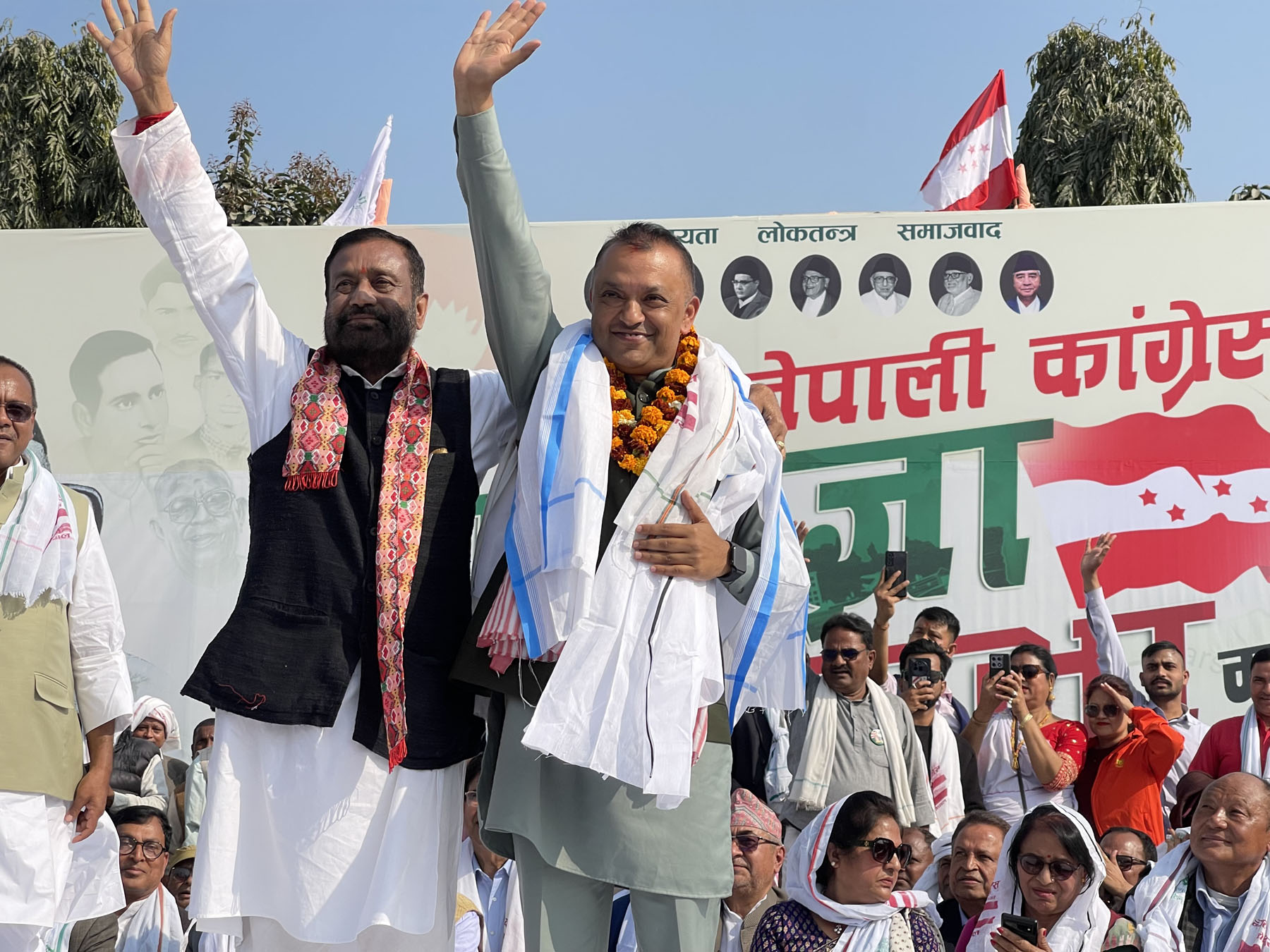
Kathmandu, Feb 18: The virtual meeting of the Nepali Congress (NC)’s Central Working Committee (CWC) held today endorsed the party’s manifesto for the March 5 election to the House of Representatives (HoR).
The meeting presided over by party President Gagan Kumar Thapa unanimously passed the party’s manifesto, informed Krishna Prasad Dulal, Acting Chief Secretary.
The NC is set to officially unveil the manifesto today at a special ceremony in Janakpur.
Party President Thapa, Vice-President Bishwo Prakash Sharma among other central leaders are scheduled to address the manifesto unveiling ceremony, it was said.
Devraj Chalise, party’s Spokesperson, asserted that manifesto unveiling ceremony to be held in the historic and cultural city of Janakpurdham is not merely a political program but a historic opportunity intended to convey a message of Madhesh’s dignity, inclusive democracy and national unity.
He shared that a press conference will be organized later today at the party’s central office at Sanepa, Lalitpur to provide details about the manifesto unveiled in Janakpur.
A briefing on the manifesto took place today at 4 pm.
—
20- RSS Employees’ Union Award to Bhandari and Dangal
Kathmandu, Feb 18: The Employees’ Union has announced that this year’s Union Award will be conferred jointly on RSS Administration Section assistant Muna Bhandari and driver Kumar Dangal.
A meeting of the Union held today decided to present the award on the occasion of the 65th anniversary of RSS, which falls on February 19 (Fagun 7).
The award carries a cash prize of Rs 10,000 and will be shared jointly by the two. Bhandari has been serving at RSS for the past 16 years, while Dangal has completed 18 years of service.
The award will be presented during a special ceremony to be held on February 19 at the RSS Central Office, Bhadrakali Plaza, Kathmandu, according to Union Chair Kalika Khadka.
The Union had formed a three-member prize selection committee comprising its advisors Prakash Silwal and Avilasha Pokhrel, and Chair Khadka.
—