- Friday, 20 February 2026
Kathmandu, Feb 19: National Assembly (NA) Chairman Narayan Prasad Dahal has said that the significance of celebrating Democracy Day lies in pledging to protect and strengthen democratic values and to take forward the democratic system in an effective and accountable manner.
In a message of best wishes on the occasion of the Democracy Day today, the Chairman of the upper house of the Federal Parliament, Dahal, stated that the parliament is an important institution for the promotion and consolidation of democracy.
He has also greeted all the Nepalis within the country and abroad on the occasion.
“The National Assembly has continuously been active in policy-making, legislative management, the institutional development of democratic practices, the protection of citizens’ rights, and matters of national interest,” Chairperson Dahal said in the message.
Paying heartfelt tribute to all the martyrs who sacrificed their lives during the political change of 2007 BS, he expressed deep respect for all the warriors who contributed at various times in the historic people’s struggles and movements for the country’s progressive change and the establishment of a democratic republic.
Chairman Dalal has expressed his wish that Democracy Day should inspire everyone to unite and move forward for the federal democratic republic, national sovereignty, freedom of expression, and the prosperity and development of the country.
Similarly, the National Assembly Vice-Chairperson Bimala Ghimire in her message of best wishes on the occasion stated that emphasis has been given on paying attention to the operation of the state governance system in accordance with the essence and sentiment of the constitution.
On the occasion of the Democracy Day, she has expressed the belief that the Day provides inspiration to engage in that work.
Vice Chairperson Ghimire has also noted the necessity of focusing on the implementation of citizens’ fundamental rights and human rights, ensuring the equitable and harmonious distribution of the benefits of democracy.
She expressed confidence that, since citizens express their opinions through elections in a democracy, the House of Representatives election on March 5 will select a leadership capable of further strengthening democracy and addressing citizens’ livelihood issues.
—
10- Former King Shah pays tribute to democracy martyrs
Kathmandu, Feb 19: Former King Gyanendra Shah has paid tribute to the known and unknown martyrs who sacrificed their lives for the establishment of democracy.
Through a video message on the occasion of the Democracy Day, the former monarch stated that that poverty and instability are Nepal’s main adversaries.
“It is time to reflect on what the changes brought about by past movements and struggles have truly given to the country and the people. There is a growing trend of seeking rights without considering duties. Therefore, everyone must think seriously,” the former King said.
Former King Shah emphasised that the culture of one Nepali considering another Nepali an enemy should be put to an end.
—
11- Officiating CEC Bhandari’s message on 10th National Election Day
Kathmandu, Feb 19: Officiating Chief Election Commissioner Ram Prasad Bhandari has called upon all political parties and candidates to engage in election publicity campaigns in a free and unobstructed manner.
In his message on the occasion of the 10th Election Day today, Bhandari also appealed to all stakeholders to create an environment conducive for participation in the election in an impartial and peaceful manner, ensuring necessary security for employees, monitors, observers, and voters involved in the election.
Officiating Chief Commissioner Bhandari stated, “I believe that the election to be held on March 5 will steer the country to the order that was disrupted after the Uprising, embracing the core mantra of peace, stability, prosperity, and good governance through a clean, independent, credible, transparent, and cost-effective election.”
It may be noted that Nepal’s first general election for the House of Representatives had begun on 7 Falgun 2015 BS and concluded on 21 Baisakh 2016 BS. This was the first general election Nepal conducted on the basis of adult suffrage.
In commemoration of the day when Nepali voters were able to exercise their sovereign right, Election Day is celebrated every year on Falgun 7.
—
12- President Paudel attends Democracy Day celebration main function
Kathmandu, Feb 19: President Ramchandra Paudel attended a special ceremony held today at the Army Pavilion at Tundikhel, Kathmandu to mark National Democracy Day-2082 BS.
President Paudel participated in the event along with First Lady Sabita Paudel.
In the ceremony organized by the National Democracy Day Main Celebration Committee, the Nepali Army offered a ceremonial salute in honor of President Paudel who is also the Supreme Commander of the Nepali Army.
During the celebration, various cultural performances were showcased reflecting country’s rich culture and heritage, including tableaux, march-past, dances and musical presentation among others.
The celebration was attended by Vice President Ramsahay Prasad Yadav, Prime Minister Sushila Karki, Chairperson of the National Assembly Narayan Prasad Dahal, ministers, Heads and representatives of various diplomatic missions in Nepal, senior government officials and distinguished members of society among others.
—
13- PM Karki addresses Democracy Day function; says HoR elections to open door to new era
Kathmandu, Feb 19: Prime Minister Sushila Karki has asserted that the government has mobilized its full strength in an effort to conduct the March 5 election to the House of Representatives in a free, fair, impartial, peaceful and fear-free environment, aiming to open a door to a new era of sustainable democratic stability in the country.
PM Karki delivered the statement while addressing a special ceremony organized today at the Army Pavilion at Tundikhel, Kathmandu marking the National Democracy Day-208 BS.
During her address, the Head of the Government expressed her confidence that the parliament and government to be formed after this election will further advance the democratic system making it more dynamic, result-oriented and accountable to the people.
Karki argued that a strong democracy does not suppress discontent; rather, it embraces as an opportunity to reform.
“Democracy should not be viewed merely as a technical change in the form of governance. In fact, it is a way of life which must be reflected in everything from of expression on the internet to the price of vegetables cooked in the kitchen,” observed the PM.
The Septuagenarian leader articulated that democracy is not just about procedures; it must deliver results.
While emphasizing that the rule of law is essential, she mentioned that keeping citizens entangled in the name of ‘endless’ processes and subjecting them to delays, harassment and distress in the name of procedure does not constitute the practice of democracy.
“It is rather mis-governance,” she underlined.
Below is the full text of PM Karki’s address;
Address by the Rt. Hon. Mrs. Sushila Karki, Prime Minister of Nepal
Right Honourable President,
Right Honourable Vice-President,
Right Honourable Chief Justice,
Right Honourable Chairperson of the National Assembly,
Honourable Ministers,
Honourable Vice-Chairperson and Honourable Members of the National Assembly,
Distinguished Dignitaries,
Heads and Representatives of Diplomatic Missions,
People’s Representatives from Provinces and Local Governments,
Government Officials,
The youth with a strong urge for change,
Friends from Media,
All Nepali Sisters and Brothers residing Home and Abroad,
Greetings.
First of all, on the occasion of the 76th Democracy Day of Nepal, I would like to pay my heartfelt tribute to all the martyrs who sacrificed their invaluable lives in the movements and struggles held in different times in history to overthrow the autocratic Rana Oligarchy and to establish democracy with people’s rights, freedom, good governance and equitable development.
The Revolution of 2007 BS (1951 AD) was not a mere change of regime. It was the promulgation of the self-esteem, rights and dignity of the Nepali people. The 7th of Falgun (18 February) that year was a historic day that transformed us from subjects into sovereign citizens. The foundation of today’s Federal Democratic Republic of Nepal is indeed the political revolution of 2007 BS (1951 AD). Therefore, we gather here today to celebrate and commemorate that historic day.
While celebrating Democracy Day, we must introspect—
Why were the gains of 2007 BS (1951 AD) taken away in 2017 BS (1960 AD)?
Why did the people have to take to the streets again in 2036 BS, 2046 BS, 2062/63 BS, and once more in 2082 (2025 AD)?
Why, this time, did even members of Generation Z feel compelled to raise their voices, undeterred by bullets?
The answer is obvious:
We chanted the slogans of democracy and inscribed beautifully crafted words in the Constitution, yet we did not institutionalize democratic practice and culture, nor did we wish to.
We embraced democracy in principle, yet in practice, we continued to foster discrimination. We wrote equality into the Constitution; yet within our structures, we went on preserving inequality.
The cycle whereby a single group continues to dominate power, monopolize resources, and wield control over state structures has never truly come to an end.
Such distortions erode trust in the state system and give rise to rebellion. That is precisely what happened here.
Let us recall the arbitrariness in budget distribution. Let us scrutinize the list of those who have benefited preferentially from the proportional electoral system. Look at the manipulation done in scholarships and employment opportunities. What else could arise, if not a rebellion?
The spirit of democracy withers away when the common person is neglected, where marginalized citizens are humiliated and where those intoxicated by power continue their lavish lifestyles and dominance.
Moreover, democracy simply cannot survive by perpetuating injustice, discrimination and exclusion against the marginalized, disadvantaged and deprived communities.
The movement led by Gen-Z youths on the 8th and 9th of September was a question directed at the structures that failed to hear the grievances of the people. That movement sought an end to corruption, nepotism and discrimination. It sought good governance and equitable justice. The State must respond to this not only with generosity, but also with humility and a deep sense of duty.
A strong democracy does not suppress discontent; it embraces it as an opportunity for reform. Cultivating such a culture is therefore the need of the hour.
Democracy today should not be viewed merely as a technical change in the form of governance. In fact, it is a way of life, which must be reflected in everything from freedom of expression on the internet to the price of vegetables cooked in the kitchen.
Lofty ideals of democracy mean little to parents who spend years working in the scorching heat of the Gulf, separated from their children, simply to make ends meet. When one cannot pay the hospital bills during illness, cannot provide a good education due to lack of money; what use then is the system and what use are its slogans?
It is long overdue that we assess the true worth of the system we have brought about in light of these everyday realities.
The true reflection of democracy must not be sought elsewhere; it should be seen in the joyful smiles that light up the faces of ordinary people and in the carefree sleep they are able to enjoy each night.
I wish to state clearly that no nation can remain peaceful by discarding its youth. Young people possess energy, a moral sense of indignation, and a deep aspiration for change. They do not tolerate nepotism, favouritism and corruption. A nation can only move forward by addressing that discontent, not by suppressing it.
Democracy is not just about procedure. Democracy must deliver results. The rule of law is essential; yet to entangle citizens in endless processes, to subject them to delay, harassment and distress in the name of procedure, is not the practice of democracy. It is misgovernance.
This government formed in the aftermath of the events of 8 and 9 September last year has taken the voice of the people’s movement with utmost seriousness. Our efforts are directed toward transforming good governance, transparency, equitable justice and accountability into practice.
However, you are equally aware that the foremost mandate of the Government is to restore peace and public order by normalising the prevailing exceptional circumstances, and to create a robust environment conducive to hold elections within a short span of time.
The main challenges confronting our democracy are corruption, the domination of resources by a limited class of people and impunity. I have come to the conclusion that these are also the primary factors why a large number of young people are migrating, leaving our villages empty.
But no one should take comfort in the emigration of young people who raise their voices for accountability. Let every ruler be warned: they are ready to endure hardship, but they will not tolerate injustice, humiliation or contempt. If future leaders continue to demean and despise the youth, another rebellion will be inevitable.
In Nepal’s electoral history, the first democratic election began on Falgun 7, 2015 BS, a historic fact known to us all. Therefore, today is not only Democracy Day but also Election Day.
And coincidentally, this year as well, the election for members of the House of Representatives is going to be held in the month of Fagun. We have devoted all our energy to holding this election in free, fair, peaceful and fear-free environment, and to opening the door to a new era of enduring democratic stability in the country.
The election will be held on the scheduled date in a secure, fear-free and credible environment. I am confident that the Parliament and Government formed after this election will further advance the democratic system, making it more dynamic, result-oriented and accountable to the people.
Finally, may this day inspire us to foster a culture of principled politics, accountable governance and prosperity grounded in social justice. May our nation become a common home for all its citizens, a home founded on equal opportunity and mutual respect.
I once again pay my heartfelt tribute to the great martyrs who sacrificed their lives for democracy. I also extend my sincere wishes for the swift recovery of those who were injured.
I express my gratitude to intellectuals, civil society, Gen Z youth, and all democracy-loving citizens.
I also appeal to everyone to join hands to unite in realizing the dream of a prosperous and just Nepal envisioned by all those brave heroes of various movements.
Thank you.
—
14- Officiating CEC Bhandari urges media not to conduct any opinion polls on HoR elections
Kathmandu, Feb 19: Officiating Chief Election Commissioner (CEC) Ram Prasad Bhandari appealed to all media outlets not to conduct any form of opinion polls ahead of the March 5 election to House of Representatives.
ECE Bhandari made the appeal while addressing a programme organized by the Election Commission here today to mark the 10th Election Day.
Bhandari reminded that since the Election Code of Conduct prohibits opinion polls, action will be taken against those who violate it.
He also underscored the need for heightened vigilance during the election period, noting that misinformation can easily spread with false news presented as true and vice versa.
Calling upon supporters of political parties to work towards conducting the election by complying with the Election Code of Conduct, he emphasized that they should refrain from defaming others through social media.
“Let us work based on truth and facts. As social media has become a sensitive issue during election, let us be careful while using it,” he requested.
Appealing to the voters, he urged them to elect the right representatives without succumbing to pressure or undue influence.
During his speech, he shared that a security meeting has been convened to devise election related security policies and strategies for the successful conduct of the election.
Furthermore, he cautioned that the Office of Election Officer in the respective districts could take action against that running election campaign in violation of the Election Code of Conduct.
The Commission also reminded election observers to perform only the duties assigned to them.
He requested all involved, including volunteer educators engaged in voter education, staff assigned to the election process, security personnel and everyone associated, to work in a way that encourages maximum voter turnout and ensures that all cast votes are counted.
Officiating Chief Election Commissioner Bhandari emphasised that even a small mistake in elections can lead to major problems, so it is necessary to work attentively with high morale.
Commission Secretary Krishna Bahadur Raut stated that election officials are being appointed and trained for the elections on March 5 in each district.
He also said that the Commission is providing many subjects related to electoral education through its website and the official social media pages of the commission. Secretary Raut informed that work is being carried out to educate voters in all 6,743 wards across the country.
Raut added that to make the elections transparent, this time the commission has passed the expenditure management procedure and mandated that political parties and candidates must also open separate accounts for election purposes.
Commission’s Joint Secretary and Spokesperson Narayan Prasad Bhattarai said that to commemorate the first election in Nepal on 7th Falgun 2015 BS (18 February 1959), the Commission started celebrating Election Day from 7th Falgun 2073 (18 February 2017).
He stated that the commission started celebrating this day every year on 7th of the Falgun month to commemorate the day when citizens voted for the first time and became sovereign.
—
15- RSS 65th Main Ceremony Inaugurated
Kathmandu, Feb 19: Vice President Ram Sahay Prasad Yadav inaugurated the 65th anniversary function of the here today.
At the ceremony held at the RSS Central Office, Bhadrakali, Vice President Yadav inaugurated the function by switching on a documentary film about RSS, which covers the history and achievements of the state-owned news agency. The program is being held in presence of various dignitaries including officials of various constitutional bodies, high-ranking officials of the Ministry of Communications and Information Technology.
At the event, annual awards are being distributed to the best journalists, employees and news correspondent of the RSS.
Established on 7 Falgun 2018 BS, the RSS has been providing to its subscribers news products in Nepali, English languages, in mother tongue, photo, audio-visual, and international news and photo service. Currently, the RSS is operating a 24-hour Nepali news service.
—
16- RSS is not only a witness to, but an archive of history: General Manager Rai
Kathmandu, Feb 19: General Manager of , Sandip Rai, has said that the RSS is not only a witness but also a recorder of history in the country.
In his welcome address to a special function organized at the RSS central office today on the occasion of the 65th anniversary of the news agency, he said that in its 65-year journey, the RSS has witnessed various ups and downs, witnessed major political, social, cultural and other changes in the country, and is thereby not only a witness but also a recorder of this long history.
“From the Panchayat era to the GenZ People’s Movement, from the constitution-making to the implementation of the federal system of governance, the RSS has not only become a witness to history, but also its archive. The RSS has fulfilled its institutional responsibility by disseminating official, reliable and fact-based news in every phase of political, social, cultural and economic change in the country.”
RSS, which has been providing news services in the country for six and a half decades, is now expanding its services in digital platforms in wake of the rapid development of information technology, General Manager Rai said and mentioned that the RSS has become the main source of reliable information not only for the entire mass media of the country but also for government agencies, diplomatic missions, the private sector and the general public.
—
17- CPN (UML) unveils its election manifesto
Kathmandu, Feb 19: The CPN (UML) has released its manifesto for the upcoming House of Representatives elections.
Chairman KP Sharma Oli launched the party’s Election Manifesto-2082BS at the ‘Desh Pahila (Country First)’ programme, organised by the UML Central Election Mobilization Committee. The election manifesto includes the party’s commitments by setting specific goals.
The UML has emphasised that the party must be made victorious to fulfill the slogan ‘Prosperous Nepal, Happy Nepalis: National Aspiration is Our Destination’.
The UML has given main importance to the areas of good governance, development, employment, and social justice which were initiated when the party was in the government, but could not be completed.
The manifesto has highlighted 11 immediate tasks, five fundamental tasks, and 25 pledges.
Addressing the programme, Chairman Oli claimed that the UML, with the determination to build rather than destroy and burn the State institutions, would lead the work of transforming the face of the country, based on the party’s past experiences and practices.
He clarified that the UML has always been steadfast in support of independence and nationalism and stated that they would not focus on populism or stunts.
—
18- Developing country requires energy of youth, vision of experienced generation: UML Chair
Kathmandu, Feb 19: Chairman of the CPN (UML), KP Sharma Oli, has stated that building the country requires the energy of the youth and the vision of experienced generations.
At the public programme to unveil the party’s election manifesto today, he said the upcoming election is a struggle between treason and self-respect.
He said, “Only when ‘fire and light’ come together will the future of this country will be bright. Our politics is that which connects, unites, and moves forward with all generations.”
The UML Chair stated that the 11 immediate actions, five fundamental declarations, and 25 pillars of prosperity outlined in the manifesto have been prioritised as policy priorities.
“We will move forward with the 11 tasks immediately, deciding and setting a timeline from the very first cabinet meeting of the government formed after the election,” he said.
Chairman Oli stated that the catastrophic event on September 9 was not an unexpected incident but a planned attack on the sovereignty and existence of the nation of Nepal.
—
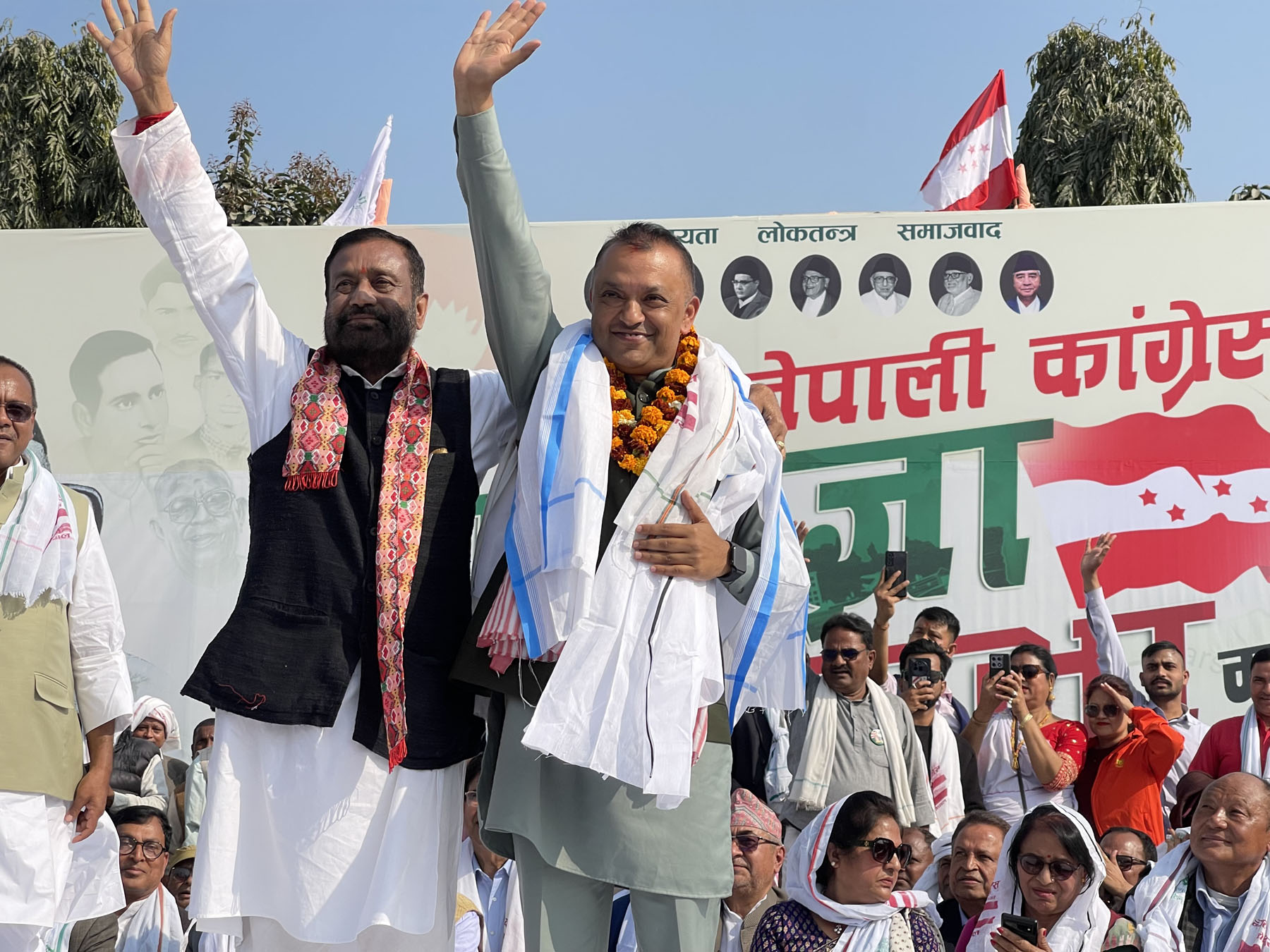
19- NC will not protect anyone involved in corruption: NC President Thapa
Kathmandu, Feb 19: Nepali Congress (NC) President Gagan Kumar Thapa said that his party aims to make country free from corruption within the next five years.
President Thapa reaffirmed the party’s stance against corruption at a programme organized by the NC here today to organize discussion and ‘Q and A’ on the party’s election manifesto unveiled yesterday in Janakpur.
During the programme, Thapa asserted, “While the NC expresses its commitment against corruption, the party does not consider person’s relation or leadership position if they are involved in corruption.”
He further cautioned, “Whoever it may be, whether the party president or anyone holding any position, if found guilty of corruption, they have no rights to remain in public office.
The newly elected President of the oldest party of the country also pledged that leaders of any political party since 2047 BS would be subjected to corruption investigation.
Underscoring the need to make public service delivery citizen-centric rather than office-centric, he viewed that any tasks should be completed with the stipulated timeframe.
He suggested that the time required to deliver services to citizens should be clearly stated and if delayed, there should be provisions for compensation.
He explained, “If it is said that something in public service will be completed in one day, then it must indeed be completed within that same day.”
President Thapa also stated that the NC has mooted plans and systematically taken them forward for digital public services available seven days a week, 24 hours a day and assured that there will be compensation if delay in service delivery.
—
20- Boy injured due to accidental gunshot in Sarlahi
Malangawa (Sarlahi), Feb 19: A child has been injured by a gunshot in Malangawa, the headquarters of Sarlahi, today.
He is Akash Ram, Ramvishwas Ram, 15, the son of Ram Bishwas Ram, a resident of Malangwa Municipality-4. The teenager was shot while playing with an abandoned pistol found at a place called ‘Dhakaborder’ in Malangwa-4.
Deputy Superintendent of Police Saroj Rai of the District Police Office said that the child was shot in the right hand in the incident.
The police stated that while inspecting an object tied with a red cloth in the corner of the under-construction Hanuman Temple at Dhaka Border, a pistol was found, and the child was injured when the supposedly fake pistol discharged during handling.
The police have stated that the injured boy is being treated at the Provincial Hospital Malangwa and is currently out of danger.
—