- Wednesday, 3 June 2026
Kathmandu, June 3: Most parts of the country will witness generally cloudy weather today, with chances of rain and thunderstorms in several regions, according to the Department of Hydrology and Meteorology.
The weather service informed that cloud cover will remain widespread over the country’s hilly and mountainous areas throughout the day, while the Tarai is likely to experience partly cloudy conditions.
Light to moderate rainfall accompanied by thunder and lightning is forecast at a few locations in the hills and mountains. Isolated showers could occur in parts of the Tarai of Lumbini and Sudurpaschim provinces.
Meanwhile, hot weather conditions are likely to persist in the Tarai belt of Madhesh, Koshi, Bagmati and Gandaki Provinces.
Tonight, weather conditions will vary by region. Mountainous areas will remain mostly cloudy, while hilly regions are likely to see partly cloudy skies. The Tarai belt is forecast to remain largely clear.
The Department has also indicated that light rain and snowfall may occur at isolated locations in the mountainous and hilly districts of Koshi Province, as well as in the higher elevations of Bagmati, Gandaki and Karnali Provinces.
—
02- Gandaki Province govt prioritizes domestic tourism thru ‘First Home, Then Abroad’ campaign
Gandaki, June 3: The Gandaki Province government has announced plans to place greater emphasis on promotion of domestic tourism in the upcoming fiscal year 2083/84 BS through initiatives such as the ‘First Home, Then Abroad’ and ‘Lake to Lake’ programmes.
Unveiling the province’s annual policies and programmes in the Gandaki Provincial Assembly on Tuesday, Province Chief Dilliraj Bhatta said the provincial government would implement a ‘One District, One Tourist Destination’ policy aimed at promoting tourism across all districts in the Province.
The initiative will also support cultural festivals, indigenous traditions, local products and lifestyles.
The government also plans to upgrade and commercialize homestay and farm-stay facilities to enhance visitors’ experiences and generate local income.
As part of efforts to strengthen religious tourism, the provincial government will develop a pilgrimage circuit connecting key religious sites, including Damodar Kunda, Muktinath Temple, Devghat and Trivenidham, according to the annual policies and programmes document.
Tourism infrastructure and emergency rescue services will also be expanded.
Among the major tourism projects, the government aims to complete the ‘Round Fewa: View Fewa’ project.
A plan to build a pedestrian selfie bridge across Fewa Lake is also incorporated in the annual policies and programmes, along with a glass bridge at Rupa Lake.
The policy also includes plans to upgrade trekking routes in the Manaslu region, Annapurna region, Dhaulagiri region and Dhorpatan region.
With an objective to boost international tourism, the provincial government has set a target of doubling tourist arrivals from India and China within the next five years through the ‘Visit Gandaki: Enjoy Nature and Culture’ campaign.
The provincial government will also focus on promoting adventure tourism and improving safety measures for visitors.
—
03- Baraili elected Chair of National Association of Dalit Community Journalists Nepal
Kathmandu, June 3: Gopal Baraili, Manager of Radio Dhankuta, has been elected Chairperson of the National Association of Dalit Community Journalists Nepal.
Baraili was elected during the Association’s second general convention held in Kathmandu on Tuesday.
The convention formed a 35-member executive committee under Baraili’s leadership while newly elected Chair Baraili shared that 10 additional members will be nominated later to complete the 45-member committee.
According to the Association, Laxman Darnal of Gorkhapatra Daily was elected senior Vice-Chairperson while Binod Pariyar (Radio Jagaran) became Vice-Chairperson (open category) and Sabitri Rasaili (Nepal Television) Vice-Chairperson (women’s category).
Similarly, Sarita Baraili (Radio Nepal) was elected Koshi Province Vice-Chairperson, Bhola Paswan (Avalokit.com) for Madhesh Province and Sushil Darnal (Rastriya Samachar Samiti) for Bagmati Province.
Other provincial Vice-Chairpersons include Narbhupal Bik (Gandaki Province), Manasingh Bishwokarma (Lumbini Province), Tekendra Rasaili (Karnali Province) and Prem Bik (Sudurpaschim Province), along with Bhim Bahadur Gandharva as Vice-Chairperson (inclusive category).
The convention also elected Karan Tamrakar as General-Secretary, along with several secretaries and a treasurer.
—
04- Indigenous Film Festival honours best films across 11 categories
Kathmandu, June 3: The Nepal Indigenous Film Federation has honoured outstanding artists, directors and filmmakers across 11 categories at the sixth Nepal Indigenous Film Festival 2083 BS.
The awards were presented during the closing ceremony of the three-day festival, organized in collaboration with the Film Development Board and the National Foundation for Development of Indigenous Nationalities.
Among the major honours, the Public Choice Award went to the Limbu film ‘Rit’, while the Gurung film ‘Ngolsyo Ramrani’ clinched the Best Film award. The same film, written by Vivek Gurung, also secured the Best Script award.
Likewise, Dinesh Lingden bagged the Best Director award for ‘Rit,’ while Kalyan Rana Magar earned the Best Actor award for the Magar film ‘Dilsara.’
Bhintuna Shrestha was named Best Actress for the Newar film ‘Swoyangu.’
In technical categories, Surya Lama took the Best Cinematography award for the Tamang film ‘Hyang Tamang.’
Similarly, the Jury Award went to the Rajbanshi documentary ‘Biratnagarkey Prachin Rajbanshi.’ The Encouragement Award was presented to the Tamang short film ‘Dukhla Gyam.’
The Magar short film ‘Lahureni’ secured the Best Short Film award, while the documentary ‘Agre’ clinched the Best Documentary award.
The festival was held at the Film Development Board hall in Chabahil, Kathmandu, featuring screenings, cultural performances, discussions and food exhibitions.
Organizers said the event aimed to promote cultural dialogue through cinema.
—
05- NC summons Central Disciplinary Committee meeting
Kathmandu, June 3: Nepali Congress (NC), the major opposition party, has called a meeting of its Central Disciplinary Committee for Thursday.
Issuing a statement, Committee Secretary Dinesh Thapa Magar said the meeting will be held at the party’s central office in Sanepa, Lalitpur.
All committee members have been instructed to attend the meeting.
The statement informed that the meeting will deliberate on internal party discipline, complaints received, and future action plans.
—
06- 76th anniversary of historic Annapurna I ascent being observed in Myagdi today
Myagdi, June 3: The 76th anniversary of the first successful ascent of Annapurna I is being commemorated today, marking a historic milestone in global mountaineering.
Annapurna I, located in the Annapurna region of Gandaki Province, lies within the Himalayan range between Myagdi and Kaski districts, with its wider massif extending toward Manang and Mustang districts.
The 8,091-metre mountain was first summited on this day (June 3, 1950) by French climbers Maurice Herzog and Louis Lachenal.
The achievement came three years before the first successful ascent of the world’s highest mountain, Sagarmatha (Mount Everest), earning Annapurna the distinction of being the first 8,000-metre peak ever climbed.
So far, a total of 536 climbers have successfully reached the summit of Annapurna I, while four expedition teams comprising 27 climbers were permitted to attempt the mountain during this spring season, according to the Department of Tourism.
Annapurna Rural Municipality Chairperson Bharat Kumar Pun informed that various programmes are being organized across the Annapurna region today to commemorate the occasion.
Pun said that a 36-kilometre trail run from Annapurna I’s base camp to Narchyang will be held, along with cultural events promoting tourism and new trekking routes.
He highlighted the events as a celebration of the country’s mountaineering heritage and the beginning of Himalayan tourism.
The celebration will conclude later today with cultural performances and an award ceremony in Narchyang, Myagdi, honouring both the mountain’s legacy and its growing role in adventure tourism.
—
07- Nepal elected Chair of First Committee of the United Nations General Assembly
Kathmandu, June 3: Nepal has been elected Chair of the First Committee (Disarmament and International Security) of the 81st session of the United Nations General Assembly, marking a notable diplomatic achievement for the country.
The election is being viewed as international recognition of Nepal’s more than seven decades of commitment to multilateralism, global peace, international security and efforts toward worldwide disarmament.
Following the election, Nepal’s Permanent Representative to the United Nations, Ambassador Lok Bahadur Thapa, expressed gratitude to member states for their trust and support.
According to the Permanent Mission of Nepal to the United Nations in New York, Ambassador Thapa has pledged to discharge the responsibilities of the position with fairness, transparency and inclusiveness.
The First Committee of the United Nations General Assembly is responsible for deliberations and decision-making on issues such as disarmament, international security, and global peace.
—
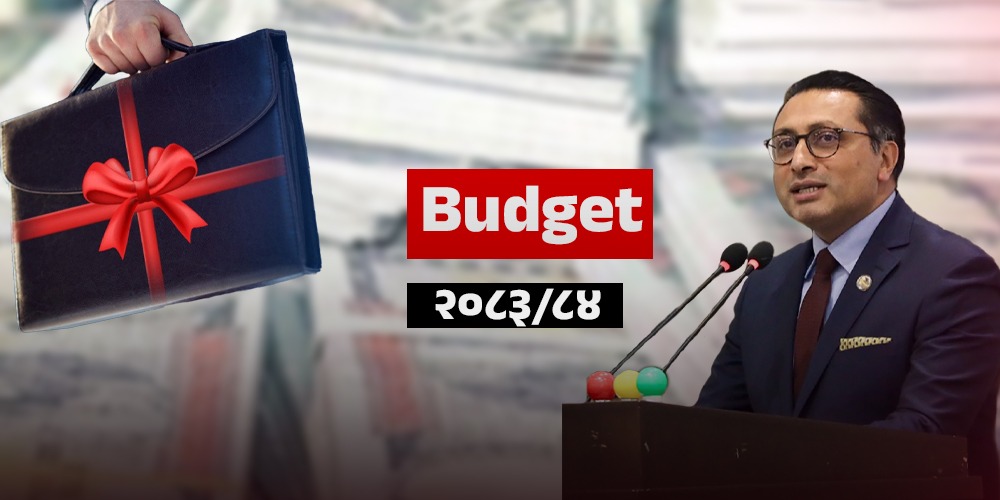
08- News Commentary: Upcoming fiscal year’s budget is a test of new government for delivery
Kathmandu, June 3: Finance Minister Dr. Swarnim Wagle tabled the budget for the upcoming fiscal year 2083/84 BS in the federal parliament on May 29, claiming that a structural departure through reforms.
The government has set an ambitious target of achieving seven percent of economic growth rate and inflation within a six percent limit. With Rs 2,124.34 billion in size, this is the largest budget in Nepal’s history but the finance minister has argued that the size of the budget is neither big nor ambitious.
“The upcoming fiscal year’s budget is not small by any means, it is relatively modest when measured against the country’s GDP,” the finance minister said at a media briefing about the budget announcement. “The budget is not overly ambitious but has been formulated within realistic fiscal limits,” he went on to argue.
The size of the budget is around 28percent of the estimated GDP, while the size of the budget increased as high as 37 percent of the GDP in the post Gorkha Earthquake. This time too, the concern on budget size is real because the increased size of the budget could lead to inflation if all other things were not well considered. The size of the budget is an issue among the stakeholders since it has direct correlation to its implementation, capital formation, inflation, job creation, fiscal stability and others key aspects of economy.
The budget’s prioritisation of the information technology sector, digitalization, including a 50 percent tax exemption on service exports and a plan to establish an AI computingcentre to bring Nepal into the AI age is a welcome step. The announcement allowing the private sector to trade electricity in international markets, the establishment of a national asset management company for bad debt management and the opening of the secondary market to Non-Resident Nepalis are all seen as steps that will positively influence the stock market.
If these provisions are implemented firmly, the morale of the private sector will rise and overall economic activity will expand. The budget’s thrust on tax reform, concessions for industry and business, promotion of the digital economy, prioritisation of technology and infrastructure development, and emphasis on the energy sector is expected to create an investment-friendly environment. Meaning the upcoming year’s budget has embraced the private sector as the primary partner and vehicle for economic growth, placing investment, entrepreneurship, innovation and expansion of financial access at the forefront.
On the energy front, the budget announces special priority to the sector as the main pillar of economic transformation, advancing structural reforms, infrastructure expansion, private sector participation, and green energy-based industrialization.
The 1,200-megawatt Budhi Gandaki Reservoir Hydropower Project is to be pushed forward under a high-powered authority. Financial closure and construction processes for the Uttarganga Reservoir Hydropower Project will begin, the 40-megawatt Rahughat Hydropower Project will be completed and the construction works of the Tanahun Hydropower Project will be accelerated. The budget also mentions that the Pokhara International Airport, which has failed to make regular international flights will be managed in collaboration with the private sector.
Economist Dr Kalyanraj Sharma is optimistic to this budget adding that this budget has offered ample opportunities for the middle-class people. Dr Sharma added that this budget is aimed at offering several choices to the middle-class people and engaging them in the nation building tasks. Surprisingly, the budget has tried to please the middle-income earner by raising of the personal income tax exemption threshold to Rs 1 million and the reduction of the maximum rate from 39 percent to 29 percent.
In this context, the Nepal Chamber of Commerce has welcomed the budget by expressing confidence that, despite the budget appearing somehow ambitious, effective implementation could help the economy gain momentum, while welcoming the income tax exemption and industry incentive policies.
But despite these announcements, economist Dr Paudel argues that the budget has limited rooms to increase production, capital formation and job creation through its implementation.
The government officials believe that this budget will expedite ongoing infrastructure projects and will boost private sector confidence, attract investment and expand economic activities upto the grassroots level, sharing the benefits both at the household and personal levels.
Some critics have also raised concerns that this budget could not uplift growth at the individual level and fails to ensure production and productivity. While government employees are set to receive a substantial salary increase, many citizens struggling with inflation, unemployment, and stagnant incomes see little direct relief. In this regard, economist and a noted development practitioner Dr Giridhari Sharma Paudel views that this budget has to struggle a bit more with its implementation if its ambitious promises are to mean anything to ordinary Nepalis.
Dr Paudel has a lukewarm response to the budget and its allocation to the agriculture sector. Agriculture remains stagnant in terms of production despite a large number of people relying on it for subsistence, with its contribution to GDP stagnating due to slower growth compared to the non-agricultural sector. Cuts to some agricultural subsidy programmes will have critical impacts, he suggested.
Offering some exemptions, providing subsidies and expanding the scope of social security are good things, but we should ensure that our economy can sustain such ‘desired burdens’ too. The budget has arrived with enthusiasm but the resource and implementation remain critical, which should be fulfilled through the assurance of resources and the assurance of implementation.
In conclusion, Nepal’s new budget unveiled by the Balendra Shah government formed after the fresh elections in the wake of Gen-Z Movement could be termed a document, which is reform-oriented, digitalization-focused, private sector-friendly and energy-focused. The budget’s credibility will be determined by what is delivered through it but, for this, implementation must improve and agricultural neglect should be corrected.
—
09- Nepal participates in United Nations International Bazaar 2026
Kathmandu, June 3: Nepal has participated in an international exhibition, presenting its symbols of cultural heritage.
The Permanent Mission of Nepal proudly participated in the United Nations International Bazaar 2026, an annual celebration of cultural diversity, friendship, and humanitarian solidarity organized by the United Nations Delegations Spouses’ Club (UNDSC), bringing together countries from across the globe.
According to the Permanent Mission of Nepal to the United Nations in New York, in the event, Nepal showcased its rich cultural heritage through a vibrant display of traditional arts, crafts, and handicrafts, offering visitors a glimpse into the creativity, craftsmanship, and identity of our nation.
It was truly inspiring to stand alongside fellow Member States, each sharing their unique traditions, authentic products, cuisines, and cultural expressions, the Permanent Mission stated in a press release today.
The event was filled with vibrant energy, captivating performances, and exciting raffle activities that reflected the spirit of international unity and goodwill. Witnessing the remarkable diversity of cultures from around the world reminded us of the strength that comes from mutual understanding, respect, and cooperation, it is stated.
Together, through culture, friendship, and compassion, we continue to build a stronger, more connected, and more inclusive world, Nepal’s Permanent Mission stated.
—
10- From huts to modern shelters: The changed face of Musahar settlement in Lahan
Siraha, June 3: The appearance of the Musahar settlement in Jahadi, Gamhariya, Ward-22 of Lahan Municipality, Siraha, has changed these days.
This settlement, which was filled with torn tarpaulin and thatched huts until few days back, now has 24 modern permanent houses standing in a row.
These safe shelters have changed the standard of living of the impoverished Dalit families who have been seeking shelter for years.
The modern houses were constructed with a bilateral investment of more than Rs 12.8 million from the Lahan Municipality and Habitat for Humanity Nepal, and with the technical support and facilitation from the local Bhawani Integrated Development Center, and local labor contribution.
This pleasant change has also brought happiness on the face of 50-year-old Shanti Sadaya from the settlement. The difficult days of having to stay awake all night whenever rainwater leaked from the roof and shivering in the cold during winter are now over forever for her and other families living in the settlement.
“Son Dharmadev, with daughter-in-law Soni and our four grandchildren, used to live in this shed. Only God knows how much hardship we endured living in this small hut. Now we have our own permanent house, and we can sleep peacefully,” said a cheerful Sadaya, pointing to the old dilapidated thatched hut next to the new permanent house.
Just like Shanti, happiness is also palpable on the faces of Jahar Mochi and Ghughari Mochi of the same neighbourhood. For them, who have been barely making a living through labor, a modern permanent house was only like a dream, which has now turned into reality.
Tuesday was a day of celebration for these 24 impoverished Musahar and Dalit families of Jahadi Gamahariya, when Mahesh Prasad Chaudhary, the mayor of Lahan Municipality, handed over the keys to houses built under the ‘Safe Housing Construction Program for Impoverished Families’ to them in a special ceremony.
For this housing project, Lahan Municipality contributed Rs 8,285,000 and Habitat for Humanity Nepal contributed Rs 2 million, while beneficiary homeowners provided voluntary labor worth Rs 2,571,000.
According to Sujit Chaudhary, Program Director of Bhawani Integrated Development Center, each newly constructed house has two rooms, a kitchen, a veranda, and a proper toilet.
These houses are earthquake-resistant, and their minimum age is more than 30 years.
—
11- Orientation on National Population Policy, 2082 held in Karnali
Karnali, June 3: The Ministry of Health and Food Safety has organised an orientation on the National Population Policy 2082 at Birendranagar of Karnali province.
On the occasion, Joint-Secretary of Population Management Division, Hem Raj Subedi, briefed about institutional, legal and financial arrangements for policy implementation as well as coordination and risk identification and management, monitoring, evaluation and review, action plan, policy revocation and prevention.
The policy has four objectives, 20 themes, 27 strategies, 120 action plans and two annexes.
Similarly, Under Secretary at the Population Management Division of the Ministry, Jhabindra Prasad Pandey, made his presentation about overall demographics of Nepal.
Likewise, Chief District Officer of Surkhet, Jagadishwor Upadhyay stressed the need of making policies to control incidents like drug addiction, road accidents and suicide as such incidents are increasing in recent period.
He pointed out for effective implementation of such policies.
Programme Officer of UNFPA Nepal Tirtha Man Tamang mentioned that it’s a great achievement to make long-awaited policy.
—
12- UML ministers in Lumbini government resign en masse
Ghorahi (Dang), June 3: CPN (UML)’s ministers in Lumbini province government have resigned en masse today.
Minister for Physical Infrastructure Development, Bhumishwor Dhakal, shared that they have tendered their resignation before Chief Minister Chet Narayan Acharya.
The UML had five ministers including the Chief Minister in Lumbini province government. Physical Infrastructure Development Minister Dhakal, Minister for Irrigation, Sita Chaudhary, Minister for Land Management and Agriculture, Dinesh Panthi and Health Minister Khem Saru resigned from the posts.
—
13- JICA Enhances Support for Nagdhunga Tunnel with Additional Loan
Kathmandu, June 3: An additional ODA Loan of 5.7 billion Japanese Yen for the “Nagdhunga Tunnel Construction Project” was signed today, bringing total loan to over 22 billion Japanese yen.
The Exchange of Notes regarding the additional assistance was signed by Ghanashyam Upadhaya, Secretary, Ministry of Finance on behalf of the Government of Nepal and Mr. Maeda Toru, Ambassador of Japan to Nepal on behalf of the Government of Japan today, the Japan International Cooperation Agency (JICA) stated.
Similarly, the Loan Agreement was signed by Dhani Ram Sharma, Joint Secretary, Foreign Aid Coordination Division (FACD), Ministry of Finance on behalf of GoN and Matsuzaki Mizuki, Chief Representative of JICA Nepal Office.
The Nagdhunga Tunnel Construction Project is designed to enhance transportation around the Nagdhunga pass, improving connectivity between Kathmandu and other important areas in Nepal.
The construction of the Nagdhunga tunnel way has reached the final phase. With about 99 percent of the physical progress being made, the tunnelway is expected to be open to the public from July 2026. The 2.68 km tunnel will significantly change travel in the region and set the stage for future infrastructure projects, supporting Nepal’s growth and development. This initiative will leverage modern tunneling technology to promote economic resilience and sustainable development beyond the tunnel itself.
This initiative supports SDG Goal 9: Industry, Infrastructure and Innovation, reaffirming Japan’s ongoing commitment to improving Road Network in Nepal.
Nepal’s collaboration with Japan, particularly through JICA, has led to significant advancements in road construction and infrastructure development in Nepal.
Some notable achievements include the 160 km BP Highway -Sindhuli Road and Kathmandu-Bhaktapur Road Spanning 9.1 km., and numerous bridges in Kathmandu valley as well as in the rural areas. Hence, it is assured that Nagdhunga tunnel will also be a world class construction in the history of Nepal’s infrastructure.
—