- Thursday, 2 July 2026
Kathmandu, July 2: The Rastriya Swatantra Party (RSP)-led government formed under the premiership of Balendra Shah is nearing its 100 days since its formation on March 27. Since its formation, this government has prioritized the policy of maintaining Nepal’s balanced relations with neighbours, bolstering economic diplomacy and multilateral cooperation.
Foreign Minister Shisir Khanal spoke to Chief of RSS Feature and Interview Section Krishna Adhikari on Nepal’s foreign policy, new government’s diplomatic priorities and other related issues stating that the government has adopted its foreign policy on the basis of Nepal’s constitution, international commitment, RSP’s election commitment paper and the government’s priorities stated in 100-point commitment made immediately after the formation of this government.
Minister Khanal said our priorities are focused on protection and promotion of our national interests.
“Increasing effectiveness of Nepal’s embassies and diplomatic missions abroad; ensuring safety of Nepali migrant workers abroad and bringing about reforms to consular services; developing a special mechanism to receive investment from Nepali diaspora; attracting foreign investment by activating economic diplomacy; institutionalizing high-level dialogues with development partners and neighbouring countries; mapping, utilizing and managing skills, knowledge, network and investment capacity of Nepali diaspora and building national pride of the country and promoting national image through effective mobilization of the country’s soft powers are included in our priorities,” Minister Khanal added.
Likewise, Minister Khanal stated that the current government expects to maintain friendly ties with the neighbouring countries including all friendly countries and development partners by keeping the national interests at the centre. Our efforts will be to advance diplomatic dialogue in a new approach by focusing national interests and maintain balanced relations with two immediate neighbouring countries India and China, he stated.
On major diplomatic achievements after the formation of this government, Minister Khanal said, “A clear message on the new government’s foreign policy has reached neighboring and international levels. The Ministry of Foreign Affairs has been working as the “First Line of Defense” in safeguarding national interests. We have prioritized promoting high-level visits and cooperation, making meetings of bilateral mechanisms regular and active, making economic and public diplomacy effective, operating the ‘MoFA Mitra’ online app to simplify and facilitate consular services, making foreign employment safe, secured and dignified while ensuring the security, rights and welfare of Nepali citizens abroad and providing supports, rescue and repatriation of dead bodies in case of deaths abroad. For this, strengthening and ensuring effectiveness of the Ministry of Foreign Affairs and our diplomacy remains a priority.”
“I believe that the visits to India and China that happened in a short time after the formation of this government made vital contributions to further strengthening the friendly and multidimensional bilateral relations,” according to the Foreign Minister.
During the visits, productive discussions took place on expanding cooperation in various areas including infrastructure, connectivity, border management, energy, trade, investment, agriculture, technology transfer, information technology and digitalization, tourism, chemical fertilizers, petroleum and natural gas exploration and people-to-people relations, he elaborated.
Minister Khanal added that important works have been carried out on strengthening Nepal’s diplomatic missions abroad, preparing a country-specific strategy with focus on economic diplomacy and holding inter-ministerial coordination meetings to chart our negotiation-focused strategies and priorities.
Likewise, he said that the government has introduced new programmes including International Wellness Day, the establishment and operation of the Nepal Diaspora Global Network and Lumbini Fellowship for the promotion of Nepal’s soft powers.
Regarding his recent India visit, Minister Khanal shared this was the first high-level foreign visit after the formation of the new government and there were considerable interests both within the country and abroad. “The relationship between Nepal and India is not merely based on relations between two governments, but on an open border, cultural affinity and people-to-people ties,” he said adding that both sides have reaffirmed their commitment to managing ups and downs through dialogue on the issues raised in the recent years due to border disputes and political misunderstandings. He said that both sides have expressed commitment to advancing the traditional friendly ties between the two countries with renew energy. “At present, the bilateral mechanisms between the two countries have become active and regular. Work is being carried out with economic cooperation at the center. Therefore, this visit can be considered a special one,” Minister Khanal argued.
Similarly, Minister Khanal said that his recent China visit was happened to further strengthen our ties with neighbouring country China. Such visits have contributed to further strengthen our bilateral relations, expand economic cooperation and mutual trust, understanding and people to people relations, adding that crucial discussions and understandings have been made to this end, according to Minister Khanal.
On Nepal’s upcoming foreign policy, Minister Khanal said that the world politics is currently entering a new phase of sharp competition and power balancing, adding that interesting projections are being made on the issue of a new world order. On this context, he underscored the need for Nepal to adopt a balanced diplomacy keeping national interests at the centre also for the maintenance of bilateral and multilateral relations to seek solutions brought about by globalization and the rapid development of information technology.
A prudent, effective and development-centered foreign policy is the need of the time for the protection and promotion of national interest, he concluded.
—
10- HoR passes Public Procurement (Second Amendment) Bill
Kathmandu, July 2: Today’s meeting of the House of Representatives has passed the ‘Public Procurement (Second Amendment) Bill, 2083’.
The bill was passed with a majority after clause-wise discussion and response from the concerned minister.
Minister for Law, Justice and Parliamentary Affairs, Sobita Gautam, on the behalf of Prime Minister Balendra Shah tabled the proposal for clause-wise discussion on the bill in the parliament. The bill was brought in the House to replace the ordinance.
—
11- 100 days of government: Innovation Ministry formed for research, promotion of science and technology
Kathmandu, July 2: Formation of a separate Ministry of Science, Technology and Innovation at a time when the government has reduced number of ministries has been taken as the new initiative in this sector.
The ministry has been formed with an objective of institutionalizing study, research, innovation, promotion and advancement of the science and technology.
The Ministry is expected to facilitate the achievement of the targeted results in this sector at a time when the country has been facing problems such as brain drain and no environment conducive to produce skilled human resources due to policy-level ambiguity and insufficient budget in the science and research sector.
After assuming the office after appointment to the post of Minister for Science, Technology and Innovation on June 10, Minister Mahabir Pun had announced to forward activities of the ministry from zero-level.
Minister Pun has been expressing commitment to working consistently to develop a culture among three-tier of governments and people how to make the country prosperous by improving economy and fostering development, research and innovation.
Minister Pun, who had served as the Minister for Education, Science and Technology before March election to the House of Representatives, has decided to introduce bill relating to innovation and carry out organization and management (O&M) survey of the ministry.
Minister Pun has been paying his attention on how to forward research and innovation effectively. The newly formed ministry has got responsibility to make policy, laws and guidelines related to science, technology and innovation. It would collect data related to science and technology, its processing, survey and determine standards.
Saying the activities related to O&M of the ministry has concluded, Minister Pun mentioned that activities to formulate important laws have been started to run the ministry.
The constitution of Nepal has made an arrangement of a policy to increase investment in scientific study, research, innovation, advancement and development of science and technology linking science and technology with country’s development as well as protect scientific, technical, intellectual talents.
The ‘National Science and Innovation Policy, 2076’ brought by the government has set a target of contributing on building a prosperous nation supporting citizen’s livelihood by increasing production and productivity through the concept of science and innovation, development of science and technology, use of innovation and promotion of scientific culture for sustainable development and prosperity.
The Innovation Ministry was formed in line with this policy and demand of time. A nine-member taskforce formed under coordination of scientist Prof Dr Dinesh Raj Bhuju had recommended this policy for economic development and social transformation by holding discussion with national and foreign experts and stakeholders.
A separate Ministry of Science and Technology was established in 2053 BS and National Science and Technology Policy was issued in 2061 and National Nuclear Policy in 2072.
The policy had determined increase in industrial production and productivity, commercialization of agriculture and use of land, sustainable infrastructure development, and sustainable use of valuable mineral resources, climate change, disaster risk reduction, good governance, service delivery, cyber and national security as the priority areas of scientific research.
There are around 120 organisation related with science and technology in the country and around 90 human resources affiliated with it.
Thousands of youths study science, engineering, information technology and other technical subjects every year in Nepal and establish themselves as capable human resources at home and abroad. However, the lack of effective mechanism to link their knowledge and skill with national development had long been felt.
It has been believed that the new ministry would lead to transform ‘brain drain’ into ‘brain gain’ by creating environment to increase investment in research, develop innovation centres and encourage scientists and entrepreneurs.
—
12- Prevention of Money Laundering (Third Amendment) Bill, 2083 passed
Kathmandu, July 2: A meeting of the House of Representatives held today passed the Prevention of Money Laundering (Third Amendment) Bill, 2083.
The meeting passed the bill with a majority vote after clause-wise discussion on the bill and response of Finance Minister Dr Swarnim Wagle.
Responding to questions raised in course of discussion on the bill, Minister Dr Wagle shared that it was necessary to hold meaningful discussion on how to curb corruption and financial crime.
He shared that 13 agencies have authority to prosecute money laundering cases and stressed the need to stop financial criminal activities from broad discussion. “We will not be able to exit from grey list if we misuse the matter like money laundering to fulfill political motives,” underlined Minister Dr Wagle.
Lawmakers—Guru Prasad Baral, Ganesh Bahadur Bishwokarma, Kamal Subedi, Chandeshwor Mandal, Yasuda Kumari Baral, Bharat Bahadur Khadka, Parbati BK, Mahendra Bahadur Shahi, Hari Mohan Bhandari and Balawati Sharma took part in the discussion.
—
13- Journalist Bhandari arrested
Mahendranagar, July 2: The Kanchanpur police today arrested journalist Khem Bhandari from Mahendranagar in connection with implementing a court decision.
Spokesperson of the District Police Office, Deputy Superintendent of Police Tek Bahadur Rawat, said that journalist Bhandari was arrested and brought to the Kanchanpur District Court during the implementation of the court’s verdict.
“In the case of libel and defamation, Bhandari was sentenced to one month and seven days in prison, fined Rs 12,100, and ordered to pay Rs 100,000 in compensation to the victim. We have now completed Bhandari’s health check and produced him in court,” spokesperson Rawat said.
The police arrested Bhandari from Katan, Bhimdatta Municipality-18. There was a defamation case filed against him regarding the Nirmala Panta murder case. The Kanchanpur District Court had convicted Bhandari guilty in May last year.
—
14- Group-wise discussion on nine ministries under Appropriation Bill concludes
Kathmandu, July 2: Group-wise discussion on headings of nine ministries under Appropriation Bill, 2083 has concluded in the National Assembly.
Discussions on the appropriation headings related to Ministry of Youth, Labour and Employment, Ministry of Information and Communications, Ministry of Culture, Tourism and Civil Aviation, Ministry of Education and Sports, Ministry of Health and Food Security, Ministry of Land Management, Cooperatives, Federal Affairs and General Administration, Ministry of Women, Children, Gender and Sexual Minorities and Social Security, Ministry of Science, technology and Innovation and Ministry for Law, Justice and Parliamentary Affairs was held in today’s NA meeting.
NA members—Samjhana Devkota, Bishnu Devi Pudasaini, Jayanti Rai, Sonam Gyaljen Sherpa, Kiran Babu Shrestha, Srikrishna Prasad Adhikari, Roshani Meche, Khamma Bahadur Khati, Buwan Bahadur Sunar, Rukmini Koirala, Gita Devkota, Suresh Ale Magar, Dharmendra Paswan, Bishnu Bahadur Bishwokarma and Basudev Ghimire took part in the discussion.
They mentioned that the budget should be focused to fulfill people’s expectations—employment creation, industrial revival, agro production growth, stopping brain drain and bringing Dalit community to state’s mainstream.
National Assembly Chairperson Narayan Prasad Dahal shared that headings related to Ministry of Industry, Commerce and Supply, Ministry of Agriculture, Forests and Environment, Ministry of Infrastructure Development, Home Ministry, Ministry of Energy, Water Resources and Irrigation, Foreign Affairs Ministry, Finance Ministry, Defence Ministry, Office of the President, Office of the Vice-President, Office of the Prime Minister and Council of Ministers and National Planning Commission would be discussed in next meeting.
The concerned ministers are scheduled to response the queries raised on appropriation headings on July 6 and 7 in NA meeting.
The NA will meet next at 1:15 pm tomorrow (Friday).
—
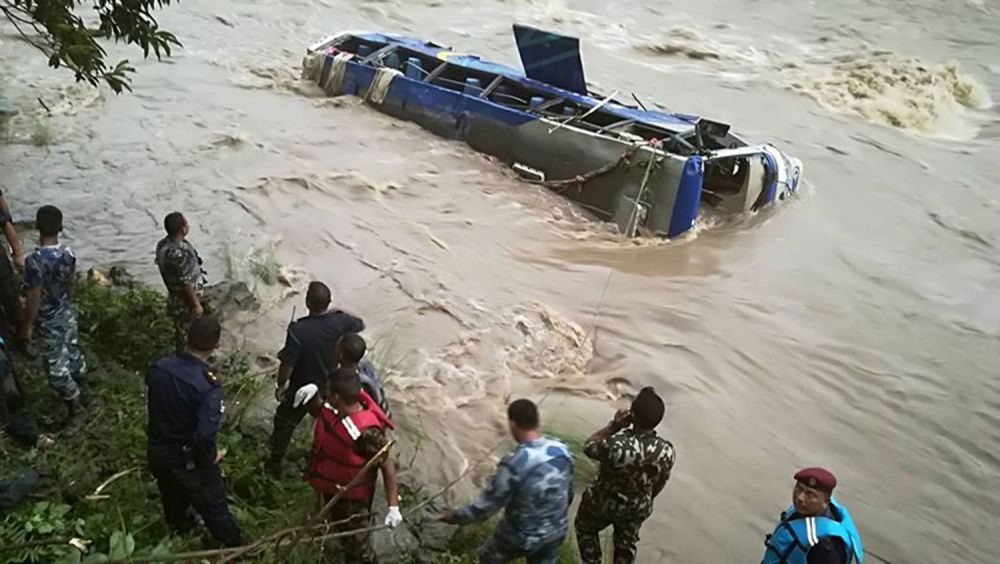
15- Fourteen people suspected to be travelling in vehicle plunged in Karnali River
Dailekh, July 2: A passenger vehicle carrying an estimated 14 people met with an accident at 11:30 am at Sangeda on the Karnali highway in Chamunda Bindrasaini Municipality–7, Dailekh today.
According to the District Police Office, the vehicle with registration number Ka.Pra. 02–00 Kha 1055, traveling from Surkhet towards Kalikot, fell about 400 meters off the road into the Karnali River .
At the accident site, the body of an unidentified male was found, according to the District Police Chief, Superintendent of Police Shrawan Kumar BK. It is assumed that the driver lost control of the vehicle and it fell into the river. A 35-member police team has been deployed for rescue at the scene. Detailed information about the accident is yet to come.
There have been difficulties in the rescue operation as the vehicle is submerged in the Karnali River. BK informed RSS that the high water level and the fact that the vehicle is submerged and invisible have made the rescue operation challenging.
Deputy Superintendent BK informed that a man, whose name and address are not known, was rescued in an unconscious state hanging on a cliff at the accident site.
—
16- 100 days of government: Info Ministry shares accomplished tasks
Kathmandu, July 2: As the formation of government nears completion of 100 days, various ministries have shared the activities they launched and executed in line with the ‘100 agendas of governance reform’.
As part of the enforcement of 100 agendas of reform, the Ministry of Information and Communications has advanced programmes relating to simplification of service delivery, digital administration and expansion of citizen-friendly services via postal office.
The Ministry shared that it accomplished the activities including the prompt administrative procedures, expansion of Nagarik App, launch of ‘Government Courier Service’ to deliver official documents to people’s doorsteps, disabled-friendly government websites, curb on illegal online betting and intensification of process to draft laws related to artificial intelligence (AI).
Business Process Re-engineering (BPR) has been in place to end the citizens’ compulsion to go through multiple levels of approval and wait for a long time. It also unburdens officials and service seekers of unnecessary paperwork for the same service. The Ministry and its subordinate bodies have been written with guideline to limit the layers of multiple approvals at maximum three.
A ‘front desk’ has been come into operation at the Ministry to make service delivery more effective. It has ensured direct submission of letters to various sections at the Ministry. The Ministry argued it has enabled service seekers to receive immediate service, with an end to delays in works.
Change in employees’ behaviour
Changing the behaviour of employees has been accorded a top priority, for which a code of conduct and a commitment letter was prepared and put in practice for employees at the Ministry and the bodies working under it. All employees have made commitment, which is directly linked to the aim of making the bureaucracy accountable, service-oriented and people-centred. It also terminates plodding and uncomfortable behaviour towards service seekers.
A draft of the Organization and Management Survey (O&M) has been prepared and sent to the Office of the Prime Minister and the Council of Ministers, while the process of preparing objective performance indicators for each position was advanced. Employee’s evaluation will be directly linked to performance in coming days, the Ministry argued.
Time to receive services down by over 50 percent
The Ministry has been successful to significantly reduce the time for some major services, such as recommendation in foreign currency exchange, film censor and classification, and permission for film and documentary filming. Such tasks used to take three to seven days, while these are done within one to three days at present. Similarly, frequency management in areas with low frequency used to take five to seven days, which is now feasible within two to four days; while of seven to 10 days in areas with high frequency is now done in seven to 10 days.
Arrangements are in place to register complaints through phone, email and social media so that seeking service and lodging complaints are made hassle-free. Addressing problem and complaints received through the ‘Hello Government’ at the Office of the Prime Minister and Council of Ministers is in equal priority. As many as 620 complaints were received through ‘Hello Sarkar’ during this period. Out of these, 347 complaints were addressed, while the rest ones forwarded to the related sections and subordinate bodies to initiate actions accordingly, according to the Ministry.
Govt service at people’s doorsteps
The Ministry has advanced the ‘Government Courier Service’ as its most ambitious scheme. Through this, the Ministry has aimed at delivering official documents to the citizens’ doorsteps. So far, more than 204,000 passports have been ferried to the District Administration Offices. The work began for distributing passports to the concerned houses of service recipients in 75 districts. Until Wednesday, 5,728 passports have been delivered to citizen’s doorsteps through postal offices.
More than 810,000 driving licenses have reached the concerned offices, while nearly 1,100 licenses are delivered at the citizen’s doorsteps in various districts. An agreement has been made with the Nepal Open University to ensure delivery of certificates to students’ homes. Transporting reports from the National Public Health Laboratory, distributing health education documents, and ferrying materials from the Health Insurance Board are also going on via postal system.
The concept of ‘smart postal services’ is launched by the government to modernize the postal system, which for some years had been losing relevance especially in the wake of digital/internet age. The Ministry of Information and Communications informed that it had selected 50 post offices across the country to develop them as smart postal services by leveraging information technology. A seven-digit postal code has been enforced for it and activities forwarded to update the system in line with the standards of international postal services. Budget allocation is ensured for purchasing new vehicles to equip postal transportation, agreements with international airlines and management of the international transportation system.
License printing in final stage
Another important task is the printing of smart driving license. The government has speeded up the printing of smart driving licenses with completion of 82 percent of the total target so far. As per the agreement signed with the Department of Transport Management, setting the target of printing 2.9 million smart driving licenses by end of June, 2,375,181 copies or 82 percent of the smart licenses were printed. The printing of remaining units is underway to complete on time and hand over to the Department.
The printing is going on for 24 hours. It will soon end the long-pending distribution of smart driving licenses.
Improvement in Telecom
The Ministry has further featured the reform in telecommunications service as the activities executed in line with 100 agendas of good governance. Data management, e-SIM, online complaint hearing, automated renewal package, one-stop service are some of the salient features launched by Nepal Telecom. Enhanced data pack is another in the reform list.
Nepal Telecom has informed that the 4G internet speed has augmented by 59.7 percent with the addition of 5-Mhz frequency in its existing capacity. It has also resulted in increase of data traffic by 24.2 percent.
Digital Nepal campaign picks a pace
With the internet and digital activities given much priority by the government, the drive for Digital Nepal has also taken a significant pace. Whether it is making public service hassle-free or the interoperability in the government system, the prompt and smooth operation undoubtedly contributes to digital transformation.
The concept of Information Technology Bill has been approved by the Ministry and forwarded to the Prime Minister’s Office. The Council of Ministers has given approval in principle for drafting AI Bill.
In view of rapid expansion of AI in Nepal, the government is making efforts to create a legal basis for its regulation. The Ministry of Information and Communications has shared that it has intensified the creation of a legal framework relating to the Nagrik App, Government Information Management System (GIOMS), automatic data filling system, disable-friendly government website and artificial intelligence (AI) so that government services would be made fully digital, transparent and citizen-friendly as stated in the 100 agenda of governance reform.
More and more government services are being featured in the Nagrik App. Discussions are held to incorporate university-related services in the App.
Provision is in place to avoid practice of submitting same documents in multiple government agencies. For it, technical arrangements have been made at the Passport Department, the Department of Transport Management and the Armed Police Force. The private banks and financial institutions have begun demanding the application programming interface (API) for similar test.
As part of the paperless administration, the government launched a campaign to strengthen the Government Integrated Office Management System (GIOMS). The Ministry shared that a total of 704 government agencies, including 354 at the federal level, 284 at the provincial level, 62 at the local level, and four corporations, have been integrated to this system. Even the employees have been trained to operate the system, and the database integrated accordingly.
The Ministry is collaborating with the United Nations Development Programme (UNDP) to develop a separate system for the provincial and local levels.
Strict action against illegal online betting is another noticeable activity of the Ministry to deter digital fraud and crimes.
—
17- Cabinet decisions: Rawal appointed general manager of Gorkhapatra Corporation
Kathmandu, July 2: The government has appointed Hikmat Bahadur Rawal as the general manager of the Gorkhapatra Corporation.
The meeting of the Council of Ministers held in Singha Durbar on Thursday took this decision. Rawal is a resident of Kailali district, according to government spokesperson and Minister for Education and Sports, Sashmit Pokharel.
The government also decided to appoint Devraj Dhungana from Morang district as the executive director of Security Printing Centre. Eight additional inspectors general (AIG) of Nepal Police have been transferred by the government.
The Cabinet also gave an approval for presenting the Agreement on the Conservation and Sustainable Use of Marine Biological Diversity of Areas beyond National Jurisdiction (BBNJ) in the parliament for its amendment.
Other decisions of the Cabinet are the endorsement of the Education (10th amendment) Regulation, 2083; the National Integrity Policy, 2083; the National Advertisement Policy, 2083; and Kamaiya (Bonded labour) Prohibition (first amendment) Regulation, 2083.
The government has given an approval for tabling the ‘Bill designed to amend and scrap some Nepal Acts’ relating to finance, according to Minister Pokharel.
Dharma Raj Khadka, a resident of Dhankuta district, has been appointed an executive director of the Special Infrastructure Operation and Management Development Committee.
—
18- Distribution of land ownership certificate begins from Bardiya
Kathmandu, July 2: The government has launched a campaign to distribute land ownership certificates to the landless and those dwelling in the unorganized places of Bardiya.
Minister for Land Management, Cooperatives, Federal Affairs and General Administration, Pratibha Rawal, began the initiative by handing over certificates to 29 households of landless Dalits and squatters at Badhaiyatal Rural Municipality-4.
The Minister reminded government’s commitment to addressing the challenges facing the landless Dalits, squatters and residents in the unorganized settlements across the country. The land distribution campaign would be gradually expanded nationwide, she informed.
The campaign keeps in centre the people deprived of land rights and provides legal documents accordingly, the Ministry stated.
—
19- Minister Yadav vows creating jobs within country
Kathmandu, July 2: Minister for Youth, Labour and Employment, RamajiYadav, has said the government had accorded much priority to creating job opportunities within country.
Addressing a programme on foreign employment opportunities organized at the Ministry on Thursday, Minister Yadav viewed supporting young entrepreneurs and business persons would help create jobs and reduce the trend of going abroad for jobs. The Ministry extends utmost support to this end, he added.
The event was organized to confer the Best Entrepreneurs National Award. The award was presented to six persons who developed entrepreneurship following their return from overseas jobs.
Lok Bahadur Rai from Morang was provided the award for this year. On the occasion, Rai shared his journey from working in Qatar to establishing a beekeeping. He viewed there is potential of securing a decent living in Nepal with the hard work as done abroad.
Manika Rai, DevlalYadav, Yam Kumar Gole, Shiv Kumar Chhetri, Dinesh Khatri and Karmaraj Malla were also provided awards.
Ministry secretary Dr Dipak Kafle shared Ministry readiness to protect workers’ rights and interests in addition to creation of a favourable atmosphere for employment.
The Ministry also honoured 13 municipalities in recognition to their status of child labour free local level.
Six industries were also honoured for meeting labour standard in employment set by the Ministry. They were Navjivan Hospital Pvt Ltd, Hongsi Shivam Cement, Ambe Steel Ltd, Asian Paints Nepal, Maruti Cement Ltd and Mainawati Steel Industries Ltd.
—
20- Transportation resumes on Miteri Bridge after technical inspection
Rasuwa, July 2: The vehicular movement halted for four days on the cross-border bridge, Miteripul on Nepal-China border, has resumed after the completion technical inspection of bailey bridge.
A Chinese team conducted the technical test of the bridge. The test was conducted to identify whether the bridge was fit for rainy season. It led to disruption of transportation.
The temporary structure was set up after the cross-border bridge was collapsed due to Lhende river flood last year.
The Area Police Office, Timure informed that both heavy and light vehicles began moving on the crossing- going to Kerung, China and coming towards Rasuwa, Nepal.
Chief of the District Police Office, Ashok Thapa, said 22 vehicles left Nepal towards Kerung on Thursday itself.
—
21- National Advertisement Policy passed; Regulations from digital ad to deep fake in priority
Kathmandu, July 2: The government has approved the ‘National Advertisement Policy, 2083’ aiming to make the advertisement sector well-managed, transparent, responsive and tech-savvy.
The policy, endorsed by the cabinet meeting today, has pointed out the need to bring the advertisement via the traditional media along with social networking sites, digital platforms, influencer marketing and artificial intelligence to the regulatory radar.
The government shared the policy was introduced keeping in mind the increasing international competition in advertisement market, influence of multi-national companies, rapid expansion of digital technology and the need of imparting right information to the consumers.
The policy stated enhancing the competitive capacity of local products, creating jobs in the advertising sector, expanding revenue, protecting consumer rights, and controlling obscene, violent, gender-discriminatory, and content that negatively affects children.
It also states that false and misleading advertisements will be subject to action, and compensation will be provided to consumers if they suffer any damage.
The government aims to significantly increase the contribution of the advertising sector to the Gross Domestic Product (GDP) within next five years.
The policy is designed to develop and expand the advertising sector, make businesses clean, competitive, respectful, and transparent, and ensure that consumers have the right to choose quality goods and services.
In order to achieve the thrust, priorities including expanding the advertising market, scientific classification of media, effective monitoring and regulation of advertisements, coordination among stakeholders, and building institutional structures have been incorporated in the policy.
Special incentives for advertising domestic goods
According to the policy, special incentives will be provided for advertising domestic goods and services, while companies selling foreign goods and services will be required to spend a certain portion of their business on consumer awareness programmes.
The government has adopted a policy to discourage the trend of presenting advertisements as news and news as advertisements. Legal and regulatory arrangements will be made to prevent situations where positive or negative news is published or broadcast based on whether advertising was given or not.
Regulation of digital advertising
The most important aspect of the new policy is the regulation of digital advertising. The government will make self-declaration mandatory for advertisements made through social media, digital platforms, and influencers.
It has been stated that AI-generated ‘deep fake’ advertisements will be legally regulated.
Strict control will be imposed on advertisements that are misleading, false, or negatively affect consumers.
The government has proposed policies to strengthen self-regulation mechanisms, codes of conduct, and enforcement systems to maintain the quality of advertisements.
Social justice a priority
The policy also gives special attention to social justice. Ads that discriminate against any class, caste, religion, language, culture, community, or gender will not be allowed.
Advertisements must respect gender and sexual minorities, people with disabilities, and marginalized communities.
Moreover, ads that warrant Nepal’s sovereignty, national flag, national anthem, national figures, or religious tolerance will be completely prohibited.
It has also been stated that using disasters, grief, or sensitive situations for commercial purposes will be banned.
The government has adopted a policy to make extensive improvements in the government advertisement distribution system.
Measures for transparency in advertisements
An integrated information management system will be developed to make the processes of distributing and paying for government advertisements transparent.
The policy has specified provisions to publish and broadcast local and provincial-level information and advertisements through media at the same level, and to distribute public interest advertisements proportionately and fairly.
Arrangements will be made to support media based on local languages, culture, and communities through advertisements.
Autonomous institutional framework
Under the institutional framework, the federal, provincial, and local levels will jointly implement the policy. The advertisement board will be developed as a more autonomous, empowered, and resourceful body.
Provisions have been made to form a provincial advertisement monitoring and regulation committee and a municipal advertisement committee at the local level.
Additionally, the policy has envisioned to form a national advertising council for monitoring, regulating, and self-regulating advertisements.
An integrated information system, information bank, and classification and grading of media will be set up to make the advertising market transparent, the policy stated.
For policy implementation, there will be extensive amendments to laws, regulations, codes of conduct, and procedures related to advertising.
Arrangement of advertisement fund
An advertising fund will be established, where money received from the government, fees, advertising businesses, and various agencies will be deposited.
Programmes for advertising market development, research, data systems, information banks, media classification, consumer awareness, and capacity building for advertising professionals will be conducted from this fund.
The ministry is also set to review the policy every year and undertake a full policy review in every five years.
Once this government policy is implemented, it is expected to bring significant changes to Nepal’s advertising market, including digital regulation, consumer protection, government ad distribution, media classification, advertising transparency, and institutional development of the advertising industry.
In particular, the provision to clearly bring advertisements through social media and artificial intelligence under regulation for the first time lays the foundation to restructure the advertising market in a new way.
—
22- HoR: Cooperative (First Amendment) Bill, 2083 passed
Kathmandu, July 2: Today’s meeting of the House of Representatives (HoR) has endorsed the ‘Cooperative (First Amendment) Bill, 2083’.
Majority lawmakers in the Lower House passed the bill which was introduced to replace the ordinance. The bill was presented for decision following deliberations and subsequent response from the concerned minister.
Responding to the queries raised during the discussion, Minister for Land Management, Cooperative, Federal Affairs and General Administration, Pratibha Rawal, said the separate bill has become indispensable with Nepal being placed in the Grey List globally in regard to the money laundering.
She also expressed commitment to incorporate the feedback received while introducing the upcoming bill.
Lawmakers, including Aren Rai, Ganesh Bahadur Bishwokarma, Ganga Laxmi Awal, Buddhi Prasad Pant, Parbati BK, Prakash Chandra Pariyar, Narendra Kumar Kerung, Basana Thapa, Sajida Khatun Siddiqi, Ganesh Paudel, Rekha Kumari Yadav, and Nita Ghatani participated in the discussion.
On the occasion, the lawmakers emphasized that the saving deposits should be returned by the respective cooperative, not by the government.
They also stressed that cooperatives should only be allowed to operate at local level where they are registered, and that there should be a single central regulatory authority.
—