- Thursday, 13 August 2026
Kathmandu, Aug 12: International Youth Day is being observed around the world, including in Nepal, today with various programmes highlighting the important role of young people in shaping society and the future.
The theme for this year’s celebration is “Different Contexts, Shared Aspirations,” focusing on the common aspirations of young people despite differences in their social, cultural, geographical and economic circumstances.
International Youth Day has been observed on August 12 since 2000 at the initiative of the United Nations.
The Day aims to promote youth-centred discussions and advocacy, increase young people’s participation in policymaking and implementation, and encourage greater investment and partnerships for youth development.
A special programme is being held at Nepal Academy in Kamaladi, Kathmandu, featuring an exhibition on information technology and startup businesses.
A youth awareness run is also being organised from Bhrikutimandap to Kamaladi in the federal capital.
The main event will feature a high-level panel discussion on promoting youth entrepreneurship and employment in Nepal.
Similarly, six businesses will receive national awards for information technology and startups, while young entrepreneurs from all seven provinces will also be honoured on the occasion.
It may be noted that a meeting of the National Youth Council, chaired by its Chairperson and Minister for Youth, Labour and Employment Ramji Yadav on July 17 this year, decided to celebrate International Youth Day in a grand manner.
According to the 2021 National Census, 12,412,173 people aged 16 to 40 accounted for 42.56 percent of the country’s total population.
—
02- Nepal, India sign MoUs for education, health and agriculture projects
Kathmandu, Aug 12: The government of India is to provide Rs 803 million in grant assistance to Nepal for eight different projects in areas including education, health and agriculture.
Authorities concerned from the government agencies of Nepal and the Embassy of India in Kathmandu signed Memorandums of Understanding (MoUs) on Tuesday for implementation of the eight High Impact Community Development Projects (HICDPs), according to a press release issued by the Embassy of India in Nepal.
Under the agreement, the B.P. Koirala Institute of Health Sciences at Dharan in Sunsari district, will undergo digitalization, while an agricultural produce collection and sales centre will be constructed in Temkemaiyung rural municipality-9 in Bhojpur district.
Likewise, a building for Belbari Multiple Campus will be constructed in Belbari Municipality-3, Morang district and a 15-bed hospital building will be built in Barju rural municipality in Sunsari district
Similarly, a cash crop and livestock centre building will be constructed in Jwalamukhi rural municipality-6 in Dhading district, while a 10-bed hospital will be built in Dungeshwar rural Municipality-5 in Dailekh district, the press release said.
Furthermore, an agricultural promotion centre will be established in Sarkegad rural municipality-4 in Humla district. Additionally, a cold storage facility will be constructed in Kaligandaki rural municipality-4 in Syangja district, the release added.
These projects will be implemented by local governments and institutions in Nepal.
—
03- Bhedetar Skywalk emerges as new tourist attraction in Dhankuta
Dhankuta, Aug 12: The Skywalk at Bhedetar in Dhankuta has emerged as a new tourist attraction, drawing hundreds of visitors daily with its transparent glass walkway and panoramic views of the surrounding landscape.
The Skywalk facility, operated by Wonders Amusement Parks and Attractions Pvt Ltd since July 26, 2024, has attracted more than 309,000 visitors in its first two years.
Of them, around 35 percent were Indian tourists, according to project officials.
One of the visitors, Anandi Kumar Chaudhary of Dewanganj, Sunsari, described his first experience of walking on the Skywalk as “unique” and “memorable.”
He said he was also looking forward to trying other adventure activities offered at the facility, such as free-fall jumping and swings.
Sanjiv Rokaha, Managing Director of the project, said plans were underway to introduce sky cycling and ziplining.
He added that a recreational park would also be built for children.
Located at an altitude of around 1,400 metres above sea level, the Skywalk offers views of the Saptakoshi River, the southern plains of eastern Nepal and mountain ranges including Sagarmatha (Mt Everest), Makalu and Kanchenjunga, according to Lilaraj Lawati, operator of Hotel Lawati Karnan.
Lawati said that the Skywalk has become an ideal destination for those seeking both scenic views and an adventurous experience.
On clear days, visitors can also soak up spectacular sunrise and sunset views, he shared.
Hotel operators in Bhedetar observed the Skywalk has helped boost local businesses, including hotels and small shops.
They, however, called for a review of the tax policy to make public-private partnership projects more sustainable and investment-friendly.
They underscored the need to adopt practical and investment-friendly policies that could help attract new projects, promote tourism and ultimately increase government revenue in the long run.
—
04- NC calls for high-level judicial commission to probe recent Sunsari and Siraha incidents
Lalitpur, Aug 12: The major opposition party, Nepali Congress (NC), has urged the government to immediately implement the agreements reached following the recent incidents in Dewanganj-Kaptanganj of Sunsari and Siraha districts.
The NC also demanded the immediate formation of a high-level, inclusive and independent judicial commission to conduct an impartial, independent and credible investigation into the incidents.
The incidents in Sunsari and Siraha followed communal clashes that erupted amid tensions between two communities, resulting in deaths, injuries and damage to private properties.
A meeting of the party’s Central Working Committee (CWC) convened at the party’s central office in Sanepa, Lalitpur, on Tuesday reminded that the NC had previously called for the formation of a high-level commission to investigate these incidents.
Issuing a press statement, Krishna Dulal, Acting Chief Secretary of the NC, lamented that innocent citizens had lost their lives in Dewanganj-Kaptanganj, Sunsari, Siraha and other places.
It also expressed concern over extensive damage to private property due to arson and vandalism.
The NC criticized that although the government had reached agreements with a commitment to provide justice to the victims, only four people had so far been declared martyrs, while other commitments remained unimplemented.
Hence, the party has urged the government to enforce the agreements without delay and initiate the necessary procedures.
Furthermore, the NC called for the effective implementation of agreements reached with various professionals and organizations, including doctors, nurses and other health workers, civil servants, relief teachers, transport entrepreneurs, dairy and sugarcane farmers, and victims of loan-sharking and other unfair lending practices.
The CWC meeting will resume at 11:30 am today as members continue to voice their views on contemporary political and other issues, informed Dulal.
—
05- NA meeting scheduled at 1:15pm
Kathmandu, Aug 12: A meeting of the National Assembly (NA) is scheduled for 1:15pm at Singha Durbar today.
The meeting of the Upper House of the Federal Parliament will record the presentation of some proposals seeking consideration of bills.
Accordingly, Minister for Culture, Tourism and Civil Aviation Khadga Raj Paudel ‘Ganes’ will present the Domestic Air Service Liability Bill, 2083 BS.
NA Secretary Tul Bahadur Kandel will table before the meeting a message received from the House of Representatives (Lower House) regarding the Bill on Reviving the Existing Provisions of the Nepal Special Service Act, 2041 BS.
Likewise, Minister for Agriculture, Forests and Environment Gita Chaudhary is also scheduled to present a proposal seeking consideration of the Infectious Animal Diseases (Control) Bill, 2083 BS.
Likewise, several parliamentary committees are also slated to deliberate on a host of issues today, according to the Federal Parliament Secretariat.
Similarly, the Finance Committee will discuss the work of the National Natural Resources and Fiscal Commission, its role in implementing fiscal federalism, challenges and the implementation status of its recommendations.
The Law, Justice and Human Rights Committee will deliberate a subcommittee report on the human rights situation of detainees and prisoners.
Other committees will discuss matters concerning child and women’s care institutions, the National Forensic Science Laboratory Bill and complaints related to the Ministry of Home Affairs.
Deliberations will also be held regarding Nepal’s preparations for participation in COP31, including the implementation of decisions and agreements from previous climate conferences.
—
06- Opinion – PM Shah’s Diplomatic Shift: Engaging India and China
Sharachchandra Bhandary
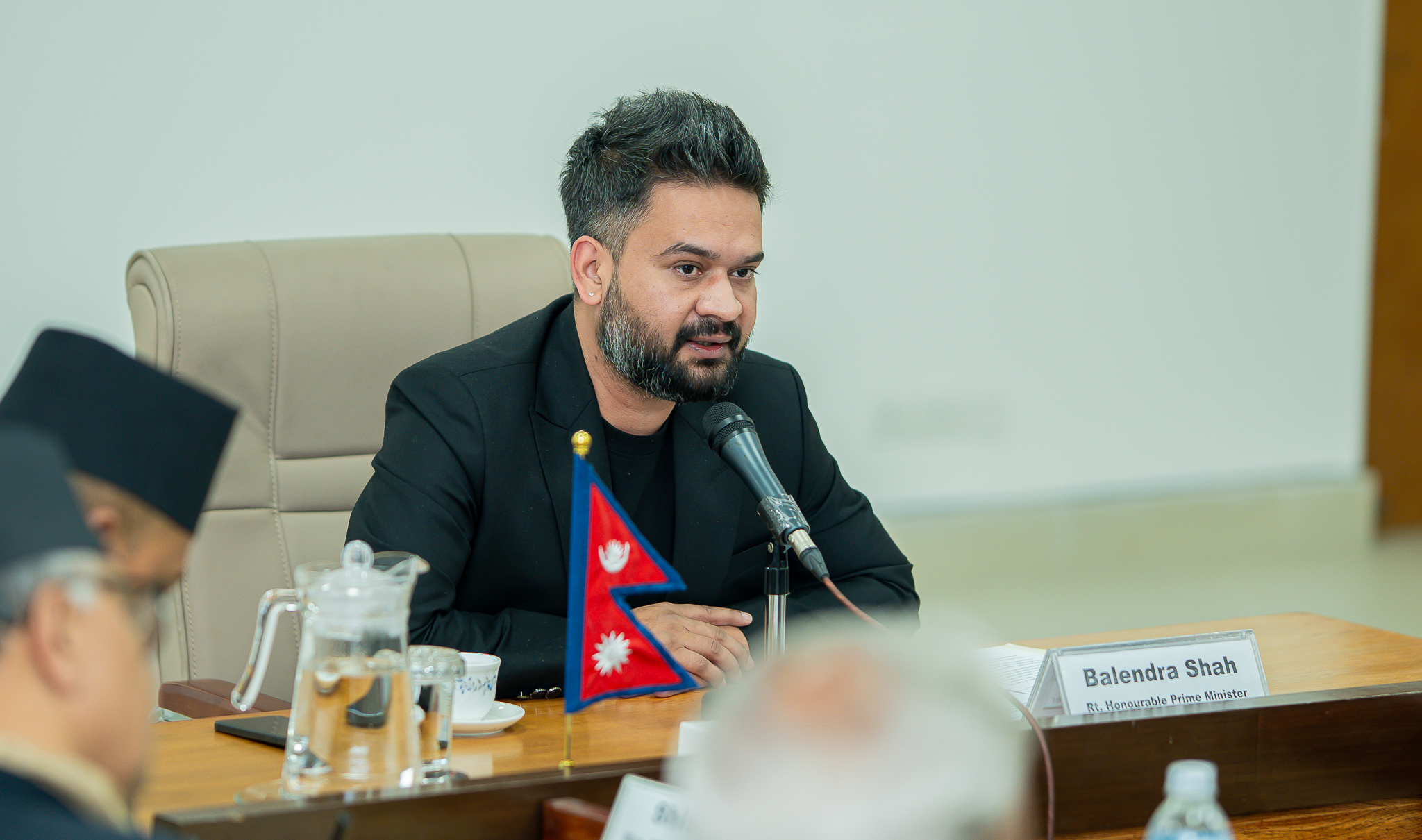
Kathmandu, Aug 12: After initially preferring to meet foreign ambassadors collectively, Prime Minister Balendra Shah has now held separate one-on-one meetings with the ambassadors of Nepal’s two immediate neighbours, India and China.
On Monday, Shah met Indian Ambassador to Nepal Naveen Srivastava and Chinese Ambassador Zhang Maoming separately at the Office of the Prime Minister and Council of Ministers in Singha Durbar. The meetings mark a notable shift in the prime minister’s approach to diplomatic engagement and could be seen as an indication of a more pragmatic phase in Nepal’s relations with its two major neighbours.
Soon after assuming office, Shah had adopted a distinctive approach to engagement with foreign envoys. Rather than holding individual meetings, he initially preferred collective interaction with ambassadors. In April, he met ambassadors and heads of diplomatic missions collectively, underscoring his emphasis on institutional channels and diplomatic protocol.
That approach generated considerable discussion in diplomatic and political circles. There was also considerable media attention when the planned visit of Indian Foreign Secretary Vikram Misri to Kathmandu was postponed in May. The visit had been scheduled for May 11, but the government subsequently said it had been postponed. Although some reports linked the postponement to uncertainty over a meeting with Prime Minister Shah, no definitive official explanation established that as the reason.
The latest meetings, therefore, are significant not simply because Shah received two ambassadors, but because they demonstrate a change in practice. Diplomacy cannot be conducted solely through formal correspondence and institutional channels. Direct communication between political leaders and diplomatic representatives is also an important instrument of foreign policy, particularly when a country seeks to build confidence, communicate priorities and identify areas of practical cooperation.
Prime Minister Shah’s meeting with Ambassador Srivastava was his first one-on-one meeting with an Indian ambassador since becoming prime minister. During the meeting, Shah emphasised the need to further deepen Nepal’s historic relationship with India and work together in areas of shared interest. Srivastava conveyed greetings from Indian Prime Minister Narendra Modi and said on X that the two sides discussed further deepening the robust and multifaceted India-Nepal partnership.
Later the same day, Shah met Chinese Ambassador Zhang Maoming. According to the Prime Minister’s Secretariat, the meeting discussed further strengthening Nepal-China relations, expanding cooperation in various fields and enhancing the development partnership between the two countries.
The fact that Shah met the representatives of both India and China separately on the same day carries a broader diplomatic significance. It suggests that Nepal intends to engage both neighbours independently rather than viewing its relationship with one through the prism of the other.
This is also consistent with the foreign-policy framework outlined by the government. Nepal has stated that it remains committed to strengthening its longstanding bilateral relations with India and China independently, on the basis of sovereign equality, mutual respect, mutual benefit and sensitivity to each other’s legitimate interests and concerns.
For Nepal, however, neighbourly relations are not merely a matter of geopolitics. They are closely connected with the country’s economic transformation. India and China are among the world’s largest and fastest-growing economies, and their continued development presents Nepal with opportunities to expand trade, attract investment, strengthen connectivity, promote tourism and deepen economic cooperation.
This explains why economic diplomacy has been placed at the centre of Nepal’s external engagement. The government has sought to use diplomatic relations to promote trade, investment, technology transfer, tourism, education and innovation.
Nepal’s location between India and China is also increasingly being viewed as an economic opportunity. The Shah government’s stated aspiration is to transform Nepal from a landlocked country into a dynamic bridge connecting China and South Asia. Cross-border transport connectivity, digital connectivity, trade facilitation and the movement of goods, services, investment, technology and knowledge are central to that vision.
Against this backdrop, maintaining meaningful dialogue with both neighbours is not a matter of diplomatic courtesy alone. It is closely tied to Nepal’s development interests. India remains a major partner in Nepal’s trade, energy cooperation, tourism, infrastructure and cross-border connectivity, while China represents important opportunities in infrastructure, trade, investment, tourism, technology and development cooperation.
The challenge for the Shah government is therefore not to choose between India and China, but to engage both effectively while preserving Nepal’s policy autonomy and ensuring that bilateral relations generate tangible national benefits.
India has formally invited Prime Minister Shah to make an official visit, although no date has been fixed. New Delhi confirmed the invitation on July 28.
The next phase will therefore be more consequential than the meetings themselves. If the new diplomatic engagement leads to concrete progress in trade, investment, energy, connectivity, technology and development cooperation, Prime Minister Shah’s shift from collective to direct diplomatic engagement could prove to be more than a change in protocol—it could become an important component of Nepal’s economic diplomacy.
For a country situated between two major powers, diplomatic isolation is hardly a viable option. Nor is aligning too closely with one neighbour at the expense of the other. Nepal’s sustainable course lies in engaging both with confidence, maintaining strategic autonomy, respecting legitimate concerns and ensuring that its relations with India and China serve Nepal’s national interest and long-term development.
—
07- Rainfall likely in parts of six provinces today
Kathmandu, Aug 12: Moderate rainfall coupled with thunder and lightning has been predicted in a few places of Koshi, Madhesh, Bagmati, Gandaki, Lumbini and Sudurpaschim Provinces today.
The Meteorological Forecasting Division has said some places of Madhesh Province and one to two places in the Tarai belt of Koshi, Bagmati and Gandaki Provinces will have moderate rainfall later today.
The weather bulletin issued by the Division stated that the weather is generally cloudy in the hilly and mountainous regions of the country at present, while it is partly cloudy in the southern plains of Koshi and Madhesh Provinces.
The southern plain areas of Gandaki, Lumbini and Sudurpaschim Provinces, however, are mostly clear.
Currently, light to moderate rainfall accompanied by thunder and lightning is being recorded in some parts of Koshi, Bagmati and Karnali Provinces, informed the weather service.
The country is currently undergoing the impact of monsoon winds, with the monsoon trough positioned around its average location, said the Division.
The Division, in its bulletin, urged people residing in disaster-prone areas and vulnerable sites to remain cautious as heavy rainfall could increase the risk of floods, landslides, debris flows and soil erosion.
—
08- Youth’s innovative thinking, energy to be utilized in nation’s prosperity: Minister Chaudhary
Kathmandu, Aug 12: Minister for Agriculture and Environment, Gita Chaudhary, has asserted that the government has put the matter of creating employment opportunities in agriculture and environment sectors at the top priority.
Issuing a message on the occasion of International Youth Day today, Minister Chaudhary expressed the view that the innovative thinking, energy and the desire of doing something should be utilized in nation’s prosperity through expansion of youth participation.
She opined that the youths have significant contribution in innovative thinking for the development of agriculture sector as well as to protect forest and environment.
Underlining that youths are the strong human resources in nation’s development, she emphasized that rural areas should be connected with technology to make youth empowerment effective.
The main slogan of this year’s International Youth Day is “Different Contexts, Shared Aspirations.” This Day has been observed on August 12 since 2000 at the call of the United Nations. The International Youth Day is observed with an objective of increasing participation of youths in youth-centric policy making and society in national and international-level.
—
09- For first time, sportspersons in majority on NSC Board
Kathmandu, Aug 12: For the first time, athletes are in a majority on the National Sports Council (NSC) board. The presence of players on the board has increased after Education and Sports Minister Sasmit Pokharel recently nominated Dhaniram Chaudhary and Lalita Nath to the board.
According to the National Sports Development Act, Minister Pokharel has nominated them to the vacant member positions through a ministerial decision.
Dhaniram, who is currently working as a coach, is a former national sprinter. He had set records in the 400 and 800 meters running competitions. Lalita Nath is a former national volleyball player. Recently, she was associated with the Karnali Yashasvi team.
Currently, Bishal Shrestha is the vice president of NSC. He is a former football player (goalkeeper). Board member Sikka Suwal Shrestha is also a former table tennis player. She had reached 510th place in the world women’s table tennis ranking. She is also the winner of the Stag Global Champion League–2080.
Shakti Gauchan is also on the NSC board. Gauchan is a former cricketer. He is also a skilled coach. He has made a notable contribution to the development of Nepali cricket.
Board member Monalisa Khambu is also a former player. She is known as a good strategist in chess. She participated internationally for the first time from Nepal as a female chess player when she qualified for the Asian Games in 2006. Among Nepali female players, she has the highest rating (1877).
Former football player Pawan Shahi is also currently a board member of the council.
—
10- Badimalika-Ramaroshan Forest Conservation Area declared
Sudurpaschim, Aug 12: The Sudurpaschim provincial government has declared the Badimalika-Ramaroshan Forest Conservation Area, which includes Badimalika of Bajura and Ramaroshan area of Achham.
At a programme organised in Dhangadhi today, Chief Minister Kamal Bahadur Shah shared that forest conservation area has been announced as per the cabinet decision of Sudurpaschim Province government held on August 4.
“The government has already made the decision with the aim of developing important forests and natural heritages of the two districts into a single conservation area. The forest conservation area was declared in accordance with Clause 26 (1) of Sudurpaschim Province Forest Act, 2077,” he argued.
Chief Minister Shah underscored that the province government is committed to make natural heritages, biodiversity and forest conservation of Badimalika and Ramaroshan areas further effective.
The conservation area has incorporated areas of Badimalaika municipality-5, 6, 7 and 8 and areas of Tribeni municipality-5, 6, 7 and 9 in Bajura district as well as areas of Mallekh rural municipality-1 and 2 as well as areas of Ramaroshan rural municipality-4, 5 and 6 in Achham district.
The conservation area has incorporated total 498.4 square kilometers areas. Badimalika is important area in terms of religious and natural tourism while Ramaroshan is famous for natural beauty, lake and biodiversity.
The Sudurpaschim Province government has believed that a foundation would be prepared for the development of ecotourism along with conservation of forest and natural resources.
It is also expected that this announcement would also prepare basis to increase collaboration between local levels of two districts in conservation and tourism development.
—
11- Online tracking system to be introduced for effective cooking gas supply: Supplies Minister
Kathmandu, Aug 12: Minister for Industry, Commerce and Supplies, Gauri Kumari, has shared that an online tracking system is going to be introduced to make cooking gas supply situation, details and supplies transparent and effective.
During a discussion related to food supply organised by Industry, Commerce, Labour and Consumer Welfare Committee today, Minister Kumari mentioned that they have started making the details public about gas distribution by filling Google Forms.
She stated that arrangement has been made for the sale and distribution of foods at Singha Durbar through stall of Nepal Food Cooperation from August 13.
Similarly, Managing Director of the Nepal Oil Corporation, Nagendra Shah, claimed that supply of cooking has would be eased within a week.
One hundred thirty four gas bullets had entered on Tuesday alone and 3.4 million gas cylinders till August 11, he added.
—
12- Social harmony appears disturbed due to misinformation and disinformation: IGP Karki
Kathmandu, Aug 12: Inspector General of Nepal Police, Dan Bahadur Karki, has said that the police organization is mobilized in a strategic way to maintain peace and order in the country and to control criminal activities.
He stated that overall, the current situation of peace and security in the country is normal, but sometimes there are criminal-minded individuals who engage in activities that affect and disrupt peace and security.
Talking to RSS, Inspector General Karki said, “The police are operating strategically to control criminal activities, fundamentally keeping in mind the need to maintain good relations and harmony among citizens, and controlling elements that try to take advantage by disturbing peace and security.”
According to him, the police have been equally alert about whether misinformation, disinformation, deepfakes, and hate speech in the social media could disrupt the cordial relations among citizens, and have, mindfully, deployed their personnel.
Regarding the collaboration, cooperation and coordination with the three tiers of the government and other security bodies, IGP Karki said, “There is regular contact and coordination amongst the Nepali Army, Nepal Police, the Armed Police Force, National Investigation Department, and concerned ministries including the Home Ministry when it comes to maintaining law and order and peace in society.
In special situations in the country, we discuss among all agencies and develop security strategies accordingly. Overall, coordinated deployment of all mechanisms has been key to normalizing security arrangements.”
He said that in the coming days as well, Nepal Police will carry out operations, coordinating with security agencies in the spirit that all mechanisms should work to strengthen peace and security and provide relief and facilitation to citizens, following the Prime Minister’s guidance.
Irresponsible use of social media disturbing social harmony
“In the past decade, Nepali society as a whole has leaned more towards materialism. Nowadays, there are many things to use, including social media, related to materialism. Many people feel that they have easily gotten these technologies for free. From using such technologies in irresponsible manner, misleading and false information spreading through social media has made people feel that a certain kind of social harmony has been disturbed,” he said of the public perception that social media was partly responsible for disturbing social harmony.
“We should start making it clear from school level that social media should be used responsibly. Everyone has an equal role in guiding society towards service, karma, and sincerity. The police work around the clock to steer Nepali society in the right direction and establish the rule of law.
Nepal Police is working through citizen-community-police partnerships to keep society informed about the damages caused by such technology. In the coming days, such activities are expected to decrease.
Sunsari-like incidents prevented largely with citizens’ yearning for peace, harmony
IGP Karki stated that because of the harmonious, friendly, and cooperative nature of Nepali society, the incident that was spreading from Sunsari to the western districts could be stopped in time by everyone’s wish for peace.
According to him, lately, it seems that there is an attempt to deviate from our own traditional religious values.
“Everyone played a role in reducing the situation where the scene we saw seemed to shake religious harmony and civic relations. That’s a very important issue. Strengthening the character and structure of Nepali society, reinforcing cultural and religious tolerance, and improving relations among citizens isn’t just the job of security agencies—it would be wrong to think so,” he added.
Emphasizing that political, intellectual, and spiritual leadership, along with respected figures from all levels and walks of life, all play an equally important role in keeping social and religious harmony, he said that politics is an important link that guides the country towards righteousness, development, progress, morality, and brotherhood, then a civilized culture.
IGP Karki further said, “When politics and culture come together in a virtuous and unique way, such incidents gradually decrease. Security personnel, political parties and leaders, and distinguished figures from the spiritual field, who want to see the nation peaceful, happy, virtuous, and prosperous, should play a role.”
Policies and programmes to strengthen policing, law and order
As IGP Karki said, the Nepal Police is making efforts at reforms from recruiting manpower to the top level organization management by adopting and working with technology, and not in the traditional way.
He opined that the traditional way of working cannot address modern needs and that’s why the Nepal Police have prepared a new performance indicator for the police personnel to motivate them and get them to carry out their duties and responsibilities.
“The performance indicators have been provided to the police commanders. It’s predictable. It clearly shows what work they did and how many points they get. There’s daily evaluation and a monthly report card. Those who get low scores will have to promise to improve next month. Those who do well will have to maintain their good standing. We’ve envisioned both motivation and balance through this,” he said.
According to him, Nepal Police has adopted technology and by using this technology, citizens don’t have to rush to the police station and they can now submit their applications and requests from home through the development of software and the ‘Nepal Police App’.
“Lately, with the rise in modern types of crimes, cybercrimes, and financial crimes, it has become necessary to deploy personnel for these cases. So there is a need to hire more technical police staff. An effort has been made to select such personnel based on their ability, interest, and skills and to have procedures in place for them,” he added.
Stating that since some people can commit crimes here from abroad, or commit crimes abroad while being here, Nepal Police’s international relations have been established through Interpol, in view of the international nature of crime, IGP Karki said the Nepal Police also have international relations through ‘police-to-police’ understanding. “We also have partnerships with countries like Singapore, Korea, and India to control crime,” he added.
—