- Monday, 18 May 2026
Kathmandu, May 18: Members of the Committee on Development, Economic Affairs and Good Governance in the National Assembly have highlighted the necessity for effective infrastructure development and budget execution.
During the meeting, the committee chairman, Krishna Prasad Poudel, stated that it is essential to ensure the effective implementation of the infrastructure plan. He underscored the importance of adopting a results-oriented approach in executing the scheme.
Ghanashyam Rijal pointed out that various shortcomings have been observed in budget execution, capital expenditure, and planning management in the past, particularly emphasizing the need to enhance capital expenditure.
Samjhana Devkota stressed that special attention must be given to construction quality and road safety, advocating for a plan to integrate settlements in rural areas. MP Kamala Pant remarked that construction workers face challenges in completing infrastructure development projects on schedule due to delays in payment.
Bhuwan Bahadur Sunuwar expressed concerns about the difficulty in obtaining the plans requested by the MPs and insisted that the implementation of the BudhiGandaki Hydropower Project should commence promptly.
Likewise, Sabitri Malla urged the government to allocate sufficient budget for the improvement of the Karnali Highway.
Gopal Prasad Sigdel, Secretary of the Ministry of Infrastructure Development, stated that the programme for the upcoming fiscal year 2083/84 BS has been advanced by prioritizing the construction of integrated urban infrastructure in cities and settlement centers where economic activities are expected to grow.
Secretary Sigdel reported that the enhancement of local roads and community accessibility, the Suspension Bridge Regional Programme, the development of alternative auxiliary highways, local center link road development, and road safety and maintenance programmes have been established as primary priorities for the coming year.
According to him, an estimated Rs 14.7 billion is required for the local-level road and community access improvement programme, Rs 4.06 billion for the Suspension Bridge Regional Programme, and Rs 21.35 billion for the alternative auxiliary highway development program.
Secretary Sigdel announced that a ‘township development programme’ has been proposed with the objective of enhancing the primary market and settlement centers of 460 villages over the next five years.
He mentioned that resource management will be implemented in various settlements of at least 58 villages in the near future.
“The Medium Urban Development Programme will be executed for the comprehensive development of the essential infrastructure in the 293 municipalities that have yet to receive significant investments,” he added.
The ministry indicated that approximately Rs 100 billion in additional resources will be necessary for the programme, with Rs 11.81 billion required for the initial year. The programme was informed that the Bagmati Civilization Integrated Development Committee has plans to enhance the physical and natural environment of Bagmati and its tributaries.
Secretary Sigdel stated that a programme has been initiated through the Kathmandu Valley Development Authority to safeguard public land, improve roadways, and aid in the creation of a dust-free city.
Similarly, the Ministry has stated that the reconstruction programmes being carried out through the offices under the Department of Urban Development and Building Construction and the Federal Secretariat Construction and Management Office are targeted to be completed within the next two years.
In the upcoming fiscal year 2083/84 BS (2026/2027) budget, road safety and landslide control work have been given high priority to ensure safe traffic on national highways.
Secretary Sigdel informed the committee in the upper house of the Federal Parliament that a highway widening programme has been proposed from the perspective of road safety. According to him, the necessary budget has been allocated for road maintenance, and the budget has been proposed to ensure that national pride projects are completed on time.
He stated that the construction of national highways and bridges will be prioritised through the Department of Roads, adding, “It has been proposed that the construction of other local roads and bridges will be carried out through the Local Infrastructure Development Department.”
Similarly, Secretary Bishwababu Pudasaini said in the meeting that the WASH has been prioritised. According to him, preparations are underway to implement an integrated programme in coordination with the federal, provincial and local levels, with the goal of ensuring clean drinking water and basic sanitation facilities for all citizens by 2087 BS.
Large and incomplete drinking water projects will be completed quickly, and the government’s policies and programmes for the next fiscal year include the development of deep boring and ground water systems to provide arsenic-free drinking water in the Tarai-Madhesh region.
He also stated that the sewerage management system will be improved to maintain the cleanliness of rivers and drains, and a water testing laboratory will be established for a regular testing system developed to increase public confidence in the quality of drinking water.
Similarly, he said that to mitigate the impacts of climate change, priorities will be given to groundwater recharge, rainwater harvesting, reservoir-based projects, and the conservation of water springs. The government plans to brand Nepali water through the ‘Himalayan Origin Certified Water’ concept.
Secretary (Water Resources) of the Ministry of Energy, Water Resources and Irrigation, Sarita Dawadi, has stated that the current government’s goal is to develop Nepal as an energy export hub. She informed that, according to the Energy Development Roadmap 2081, a target has been set to produce 35,000 megawatts of electricity within the next 10 years. She emphasised that special focus should be given to the construction and expansion of transmission lines to achieve this goal.
Secretary Dawadi stressed on the need to prepare a clear roadmap for the restructuring of the Nepal Electricity Authority and stated that the Electricity Bill should be drafted. She also stressed that the renewable energy and energy efficiency bills should be approved promptly. According to her, a clear division of roles and powers is necessary among the Investment Board, the Electricity Regulatory Commission, and the Electricity Production Company Limited for large projects above 200 megawatts.
She mentioned that the roles and autonomy between those bodies are not clearly defined at present.
Secretary Dawadi also suggested that arrangements should be made for the multi-year procurement of consulting services with an estimated cost of less than Rs 200 million under the Medium-Term Expenditure Framework (MTEF) to be approved by the accounting officer.
—
16- HoR meeting: MPs call for effective supply of seeds, fertilizer before paddy planting season
Kathmandu, May 18: Legislators have indicated that the season for paddy planting is nearing with the arrival of rain and have urged for timely provision of fertilizers, seeds, and agricultural equipment.
During the zero hour of today’s HoR meeting, MP Achyutam Lamichhane called for addressing farmers’ issues by supplying fertilizers, seeds, and agricultural tools.
Anushka Shrestha requested solutions to the challenges faced by the Nepal Tourism Board. Apsana Banu expressed concern over the difficulties in repatriating the remains of individuals who lost their lives while working abroad and urged attention to the welfare of those who seek employment overseas.
Abhishek Pratap Sah called for a thorough investigation into the assets of former Home Minister Sudan Gurung while Amrita BK recommended that the government make decisions that do not conflict with judicial rulings.
Ambikadevi Sangraula insisted on utilizing domestic energy resources instead of spending billions on fuel imports. Arjun Kumar Karki requested assurance of resources to finalize the Kimathanka border crossing, as the route has recently been opened.
Arjun Narsingh KC called for the publication of the Gauri Bahadur Karki Commission report. Ashok Kumar Chaudhary urged that local authorities refrain from actions based on political affiliations, given that the school management committee has been established on such grounds. Akriti Awasthi advocated for enhancing the reliability and convenience of the digital banking system.
Aryan Rai demanded an investigation and disclosure of the truth, as despite government claims of free tickets and visas for overseas employment, workers are unable to travel abroad without incurring substantial costs.
Likewise, Asha Jha stressed the need to address the electricity and the telephone tower issues in Constituency No.-5.
Ashish Gajurel inquired about the feasibility of traveling via public transport. At the Sindhuli District Hospital, the X-ray machine has been out of order, and despite long-standing requests, it has not been received, he complained.
Ashika Tamang urged the relevant agencies to address the numerous issues on the highway in Dhading. She stated that adequate charging stations should be set up, as electric vehicles often run out of charge.
Indira Ranamgar called for a resolution to the issue concerning 11 bigha of land in the Arjundhara area of Jhapa while Yashoda Kumari Baral insisted that Nepalis facing difficulties after seeking employment abroad should be repatriated without delay.
Ankita Thakur advocated for an increase in tourism through the enhancement of infrastructure at the Chinnamasta Bhagwati Temple.
Kabindra Burlakoti requested the authorities concerned that the poles and wires be replaced, as the lights flickered even during normal wind conditions in several municipalities of Gorkha.
Kali Bahadur Sahakari highlighted the issue that the government fails to heed the opposition, leading to complications when it acts independently while Kusum Maharjan called for action against individuals involved in the misuse of tax funds as the situation escalated.
Kripa Maharjan urged the implementation of a policy to prohibit the sale and distribution of foreign goods in the heritage areas of the Kathmandu Valley.
KP Khanal requested the prompt completion of the Seti Highway in Sudurpaschim Province, which has faced prolonged delays.
Krishnahari Budhathoki sought solutions to various issues in Ramechhap, including telephone problems, a lack of drinking water, monkey-related disturbances, the use of chemical fertilizers, and other concerns.
Kranti Shikha Dhital expressed that there is a misconception that knowledge is solely assessed by physical attendance at Tribhuvan University, advocating for quality education to be prioritized, especially for those who do not learn effectively even while present in class.
—
17- Deliberations on the principles and priorities of the Appropriation Bill begin in HoR
Kathmandu, May 18: Discussions have begun in today’s meeting of the House of Representatives on the principles and priorities of the Appropriation Bill for the fiscal year 2083/84 BS (except for the tax proposal).
Earlier on May 14, Minister for Finance, Dr Swarnim Wagle, had presented the very principles and priorities during the HoR’s meeting. The discussion is being viewed as part of the pre-budget deliberations.
Parliamentarians representing their respective parties have put forth their views on the proposal as well as on contemporary issues in today’s meeting.
Accordingly, Rastriya Swatantra Party (RSP)’s lawmaker Jhabilal Dumre stated that his party stands apart from those ‘making hallow and fake promises’ and its party’s lawmaker would deliver through their actions rather than rhetoric.
He stressed that the construction of the Siddhartha Highway connecting Gandaki and Lumbini Provinces should be given priority.
Likewise, Nepali Congress’s Basana Thapa commented that the document outlining the principles and priorities was readable and well-prepared but, she criticized, it failed to kindle hope and ignite confidence among the youths regarding employment opportunities.
Thapa also suggested that all three-tier government should work together more effectively by avoiding duplication.
Also voicing the views, CPN (UML)’s Dr Pushparaj Kandel slammed the proposal, saying it failed to incorporate the Constitution’s three-pillar economic policy and socialist-oriented goals.
He also accused that the proposal was apathetic about enabling favorable business environment for private sector.
Airing the views, Rastriya Prajatantra Party’s Khusbu Oli pointed out that the State should prioritize boosting agricultural production.
Independent parliamentarian Mahabir Pun urged the government to provide subsidies for registering patent rights related to industries and businesses.
He also called on the government to consider allocating at least one percent of the total capital expenditure for research and innovation.
Likewise, Shram Sanskriti Party’s Harkaraj Rai demanded that a provision that allows businesspeople to pay taxes through local governments to reduce travel burden.
Stating that his party protested by displaying placards in the parliamentary meeting, he decried that the government was not being responsible toward parliamentary meetings.
He also called for budget allocation for embankment in the Saptakoshi-Dharan areas, drinking water and construction of landfill sites in the upcoming budget.
—
18- RSP lawmakers decry Acting CJ Malla’s order on registration of writs
Kathmandu, May 18: In today’s meeting of the House of Representatives, MPs from the Rastriya Swatantra Party (RSP) expressed their objection that Acting Chief Justice of the Supreme Court, Sapana Pradhan Malla, ordered the registration of a writ petition contrary to legal precedence and practice.
Samiksha Baskota and Yagyamani Neupane expressed the view that it is not acceptable to consider as good the order to register a writ petition against the decision taken by the Constitutional Council regarding the recommendation process for the future Chief Justice.
Stating that although they were clear the independent judiciary should carry out its works independently, they expressed disagreement with actions taken outside the administration of justice.
Then after the MPs from the CPN (UML) raised objections to the statements made by the RSP lawmakers, arguing that they were contrary to the rules of procedure that prohibit discussion on judicial matters in Parliament.
—
19- Nepal elected Vice President of 79th World Health Assembly
Kathmandu, May 18: Nepal has been unanimously elected as the Vice President of the 79th World Health Assembly of the World Health Organization (WHO).
The World Health Assembly is the decision-making body of the WHO.
According to Dr Samir Kumar Adhikari, Deputy Spokesperson at the Ministry of Health and Population, the election took place during the opening session the assembly held today in Geneva, Switzerland.
Deputy Spokesperson Adhikari also stated that Minister for Health and Population, Nisha Mehata, is scheduled to address the assembly later today on behalf of Nepal.
A Nepali delegation led by Minister Mehata had left here for Geneva on Sunday to participate in the global health gathering.
The 79th World Health Assembly is being held in Geneva on May 18-23.
—
20- National Economic Census: Approx 87 percent completed
Kathmandu, May 18: The Second National Economic Census, 2082 initiated by the National Statistics Office, has progressed 87.08 percent so far.
The progress of the census so far has been disclosed through a press conference held today at the NSO Thapathali office.
The Deputy Chief Statistics Officer and spokesperson Dhundi Raj Lamichhane said that the counting which started on April 15 will continue until June 21.
In the meantime, enumerators across the country have collected field data and so far distributed more than 800 thousand paper forms and over 10 thousand ‘Census Tokens’, he informed.
The Chief Statistics Officer Dr Kamal Prasad Pokhrel stated that on-site data collection is vigorously ongoing and urged the institutions involved in the counting to provide accurate and factual information. He also requested that journalists working in radio particularly help facilitate the process by promoting awareness about the ongoing economic census.
Dr Pokhrel expressed the view that the National Economic Census could serve as an important basis for the government to achieve its upcoming goals.
He said that economic census would be effective for purposes such as obtaining details on business establishments, businesses, their numbers, information on their employment and economic status, which would help in the timely strengthening of other estimates of gross domestic product and national accounts, and obtaining statistical ‘sample frames’ to conduct establishment-based surveys, and formulating and evaluating economic development policies, plans and programmes for all governments in the federal structure.
—
21- Nepal defeats Scotland by six wickets
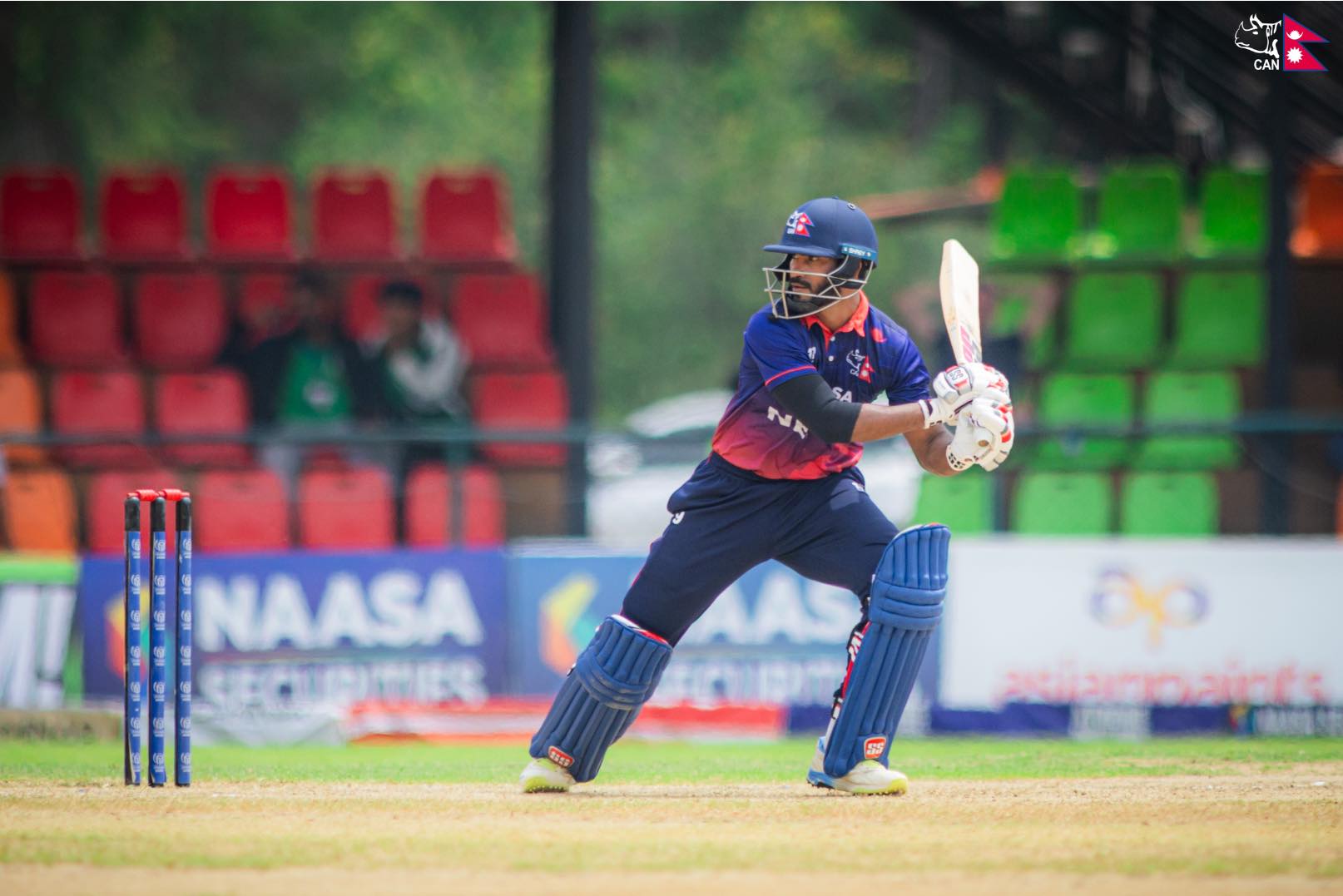
Kathmandu, May 18: Nepal defeated Scotland by six wickets in today’s match held under the ongoing ICC World Cup Cricket League-2.
A 195-run victory target posted by Scotland in Kirtipur-based TU Cricket ground, Nepal met the target in 38.1 overs by losing four wickets.
For Nepal’s victory, Captain Rohit Poudel scored the highest 74 runs in 98 balls. Similarly, Ishan Pandey made 55 runs in 61 balls, Asif Sheikh gathered 29 runs and Kushal Bhurtel collected 29 runs.
Towards bawling, Mark Watt took two wickets while Brandon McMullen took one wicket.
Earlier, elected to bat first after winning the toss, Scotland scored 194 runs in 39.1 overs at the loss of all wickets. For Scotland, Brandon McMullen scored the highest 73 runs in 44 balls while Michael English collected 51 runs, Gorge Munsey made 21 runs and Mark Watt gathered 20 runs.
Similarly, Lalit Rajbanshi and Sandeep Lamichhane of Nepal took four wickets and three wickets respectively. Likewise, Dipendra Singha Airee, Sompal Kami and Nandan Yadav took one wicket each.
With this victory, Nepal is in the fifth position with 22 points in the championship, where eight nations are participating.
—
22- Lawmakers emphasize implementation of principles and priorities of Appropriation Bill
Kathmandu, May 18: The Members of Parliament (MPs) in today’s House of Representatives (HoR) meeting said the issues included principles and priorities of the Appropriation Bill for the fiscal year 2083/084 BS should be duly implemented.
Taking part in principles and priorities of the Appropriation Bill (except for tax) for the fiscal year 2083/084 BS, the lawmakers said that the trend of poor implementation of the past should be ended in the upcoming fiscal year.
MP Ashish Gajurel said capital from the Nepali Diaspora community should be brought in through procedural and policy-level decisions adding that there was a shortfall of nearly Rs 400 billion for infrastructure development.
MP Guru Prasad Baral called to establish the Human Resource Development Bank.
Likewise, MP Parshuram Tamang said that the principles and priorities of the government should be introduced by aligning with the constitution’s directive principles and the 16th plan.
MP Mohammad Firdos argued that Nepalis were further pushed to below the poverty line because of our costlier health services.
Ain Bahadur Mahar claimed that the principles and priorities of the Appropriation Bill failed to grasp the clear roadmap of fiscal federalism.
Lawmaker Barshaman Pun stated that the development of infrastructure was inevitable for e-governance.
Lawmaker Aren Rai said that massive reform measures should be initiated to upgrade the quality of education and the results.
—
23- Deliberations ongoing on principles and priorities of Appropriation Bill
Kathmandu, May 18: The deliberations on the principles and priorities of the Appropriation Bill (except tax) for the upcoming fiscal year will continue on Tuesday as well.
According to Speaker of the House of Representatives (HoR), Dol Prasad Aryal, deliberations on the principles and priorities of the Appropriation Bill will continue on Tuesday as well. The deliberations on the document started on Monday.
Finance Minister Dr Swarnim Wagle had tabled the principles and priorities of the Appropriation Bill at the HoR meeting on May 14.
Likewise, Dr Wagle would respond to the lawmakers’ concerns on the document on Wednesday.
The next meeting of the HoR is summoned for 11:00 am on Tuesday.
—
24- Amrit Jha still in police custody in Iran; diplomatic efforts underway for impartial hearing
Kathmandu, May 18: The Foreign Ministry has stated that diplomatic efforts were underway to ensure an impartial hearing in a case of Nepali citizen Amrit Jha, who is in police custody of Iranian forces for investigation.
Issuing a press release on Monday, the Foreign Ministry made it clear that diplomatic efforts are ongoing for all necessary legal processes including the impartial hearing on the case of Jha by using all available means. Jha is in police custody on the charge of smuggling illegal goods in Iran.
The Foreign Ministry stated that the case related to Jha is under consideration at the local court of Iran, apologizing for the confusion created due to an unofficial report of his release at a time when he is in custody.
Iranian security personnel had arrested Jha as well as six other foreign nationals from Qeshm Island one month before the US-Israel and Iran tension. The tension between the US-Israel and Iran started on February 28, 2026.
On April 15, Nepal’s honorary consul in Iran Shahram Shantiya communicated with Nepal’s Deputy Chief of Mission in Qatar, Kumar Rai, sharing the news of Jha’s release. The Ministry’s concerned Division submitted the report to Minister Khanal and Secretary Amrit Bahadur Rai and, based on the same information, the Ministry had released the issue on Jha’s release.
Likewise, the Embassy of Nepal in Doha, Qatar, was directed to submit written evidence about his release to fulfill the processes for his repatriation back home.
The Ministry has made it clear that the issue was informed to the Jha family during a meeting with Minister Khanal and top-ranking officials of the Ministry.
The Ministry has stated that the needed legal processes have been advanced to repatriate him back home, as Jha was yet to be released and the court has ordered to prepare a report in the case related to Jha.
—
25- UML to renew former President Bhandari’s party membership
Bhaktapur, May 18: The CPN (UML)’s secretariat meeting held on Monday decided to renew the party membership of former President Bidya Devi Bhandari.
A secretariat meeting held at the party Chairman KP Sharma Oli’s residence at Gundu in Bhaktapur decided to give party membership to former President Bhandari, according to UML’s assistant general secretary Lekhraj Bhatta.
Likewise, the meeting reviewed the current government’s performance, renewal and expansion of the party membership and portfolio division of party office-bearers.
Bhatta stated that 11 different proposals were submitted at the meeting today.
The next secretariat meeting of the UML is scheduled to be held on May 21.
—
26- National Women Commission shifts its office to Narayanhiti
Kathmandu, May 18: The National Women Commission is preparing to provide its services from the then building of the Department of Passport at Narayanhiti Durbar.
Commission’s Member and Spokesperson Krishna Kumari Paudel Khatiwada said that administrative jobs were started from the new office at Narayanhiti Durbar and all other services will be delivered from the new location within a week.
The Commission’s Bhadrakali-based office has continued 1145 helpline and complaints-related services, but these services will also be handled from the new office soon.
The Commission had been providing its entire services from the Bhadrakali-based office since its establishment.
“Now, the Commission won’t have to pay the rental charge. Also, the dignity of the constitutional commission will be maintained,” Paudel added.
A meeting of the council of ministers held two and a half years ago had decided to shift the Commission’s office to Narayanhiti Dubar but it was delayed due to some administrative reasons.
—
27- Small depositors of troubled cooperatives being repaid
Kathmandu, May 18: The government has started refunding deposits of small depositors affected by the crisis-hit cooperatives.
The Problematic Cooperative Management Committee paid back deposits of 378 depositors of three such cooperatives on Monday.
According to the Committee, 215 depositors of Kantipur Cooperatives, 156 of Shiva Shikhar Multipurpose Cooperatives and seven of Pashupati Cooperatives got their deposits back.
At the first day on Monday, the committee refunded the amount of certain minimum depositors and the remaining depositors will be categorized based on the size of deposited amounts and will be paid back gradually, shared the Secretariat of the Minister for Land Management, Cooperatives, Federal Parliament and General Administration, Pratibha Rawal.
Around Rs 46 billion deposits of around 76,000 depositors of the troubled cooperatives have to be refunded, added the Committee. Of them, most of them are small depositors.
Depositors who have deposited less than Rs 500,000 have been categorized as small depositors and those who have deposited more than Rs 500,000 as large depositors.
Out of 76,000 depositors, the number of depositors depositing more than 500,000 is 18,000. Minister Rawal shared that activities are underway to recover loans of cooperatives to refund the savings of depositors.
According to the Committee, more than 20 million loans have already been recovered from borrowers of the problematic cooperatives. Loan recovery and refund of deposits would continue simultaneously, mentioned the Committee.
—