- Wednesday, 3 June 2026
Kathmandu, June 3: Positive initiatives taken by the government to establish information technology sector as the major basis of country’s economic transformation through budget of the coming fiscal year have been welcomed.
Issuing a press release, the Nepal Association for Software and IT Services Companies (NAS-IT) welcomed such initiatives of the government, expressing belief that such move would make positive contribution to increase Nepal’s IT export, earn foreign exchange, create employment as well as to establish Nepal as a global digital services destination.
Announcement of various programmes like tax concession on income from export of information technology services, improvement on tax management related to sweat equity provided to human resources of IT field, limiting highest-personal income tax to 29 per cent from 39 per cent, making VAT refund process more systematic and automated, and incorporating programmes to promote artificial intelligence, innovation and digital economy in coming budget are significant achievements for development of IT industry, reads the statement.
The Companies expressed commitment to remain active to establish Nepal as a leading digital and IT Services Centre in South Asia as well as to create high-paying IT-related employment in the country.
The Companies also drew attention of the government for not incorporating some significant policies and structural arrangement related to IT sector in the budget of coming fiscal year but incorporated earlier in government’s 100-point agenda and national commitment paper.
—
15- CNI believes Budget for FY 2026/27 will give new direction to economy
Kathmandu, June 3: The Confederation of Nepalese Industries (CNI) has expressed its belief that the budget for the fiscal year 2083/84, recently presented by the government, will lay the foundation to give a new direction to the country’s economy.
It said in a press release today that the effective implementation of this budget, which has been brought with a focus on industrial promotion, will not only spur domestic production but also attract foreign investors.
CNI stated that the decision to reduce customs duties on 273 items to create a single layer in customs for finished products and raw materials for production-based industries will help make domestic production competitive and accelerate the pace of industrialization.
The Confederation believes that the abrogation of excise duty on 360 items will help reduce production costs.
Similarly, CNI stated that the proper use of forests and natural resources, green industrialization, prioritizing employment creation and import substitution, and the construction and operation of industrial zones like Motipur and Mayurdhap by the private sector will encourage the private sector.
According to the press release, the CNI believes that reviewing electricity demand charges to enhance the competitiveness of production-based industries, providing discounts on electricity tariffs, and allowing industrialists to mortgage structures built on land available in industrial estates, special economic zones, and on lease for banking purposes will encourage industrialization.
“The provision for automatic value-added tax refunds, the resolution of disputes by paying an additional 1% on disputed taxes, and the arrangement where interest, fines, etc., are not applied is extremely practical. Many industrialists and investors have been entangled in cases for years. This arrangement will provide them significant relief, help them focus on productive activities, facilitate the return of profits and royalties, and the announcement to make returns easier appears to attract foreign investment and play an important role in creating an investment-friendly environment,” the press release said.
Similarly, CNI stated that raising the personal income tax limit to Rs 1 million and reducing the maximum rate by 10 percent is an important step for the economy, and only if the purchasing power of consumers can increase will the industry, trade, and service sectors gain momentum, and the measures made by the budget will help expand demand in the economy.
“The decision to dissolve and merge government bodies will bring significant improvement to government efficiency and reduce unnecessary expenditure. It will create a legal provision whereby projects approved by the Investment Board do not need further approval from other agencies. Permits for projects that have electricity purchase agreements but have not started construction will be canceled and a new PPA will be made on a ‘take or pay’ basis. The CNI believes that using alternative development finance funds, offshore bonds, clean energy bonds, diaspora bonds, and climate funds to mobilize private investment in infrastructure aims to attract private investment for the projects.
The operation of employment linked production zones as models for the development and expansion of labour-intensive industries including agro-processing, tourism service and light products, investment promotion, economic reforms and smooth service delivery will help boost the economy,” reads the CNI press release.
CNI also welcomed the Budget Statement for FY 2026/27, stating that provisions related to ensuring financial access for small and medium entrepreneurs by credit protection with ‘First Loss Recovery,’ providing ‘Business Revival Loans’ to industries and businesses unable to operate at full capacity due to capital shortages to encourage capacity expansion and growth, promoting the production of ‘Green Urea’ by the private sector through purchase guarantee agreements and providing electricity at concessional rates, establishing legal provisions related to the corporate social responsibility of industrial establishments, and establishing the Nepal Enterprise Facility as a platform to integrate startups, small, and medium enterprises into the national enterprise ecosystem are positive matters.
The CNI stated that physical and financial incentives for resorts and hotels targeting high-value tourists, as well as health tourism branding, will help strengthen the economy.
However, the CNI complained that the budget has overlooked the issue of promoting quality and importing quality goods. Similarly, it suggested that policies should be adopted to ensure that productive industries are not subjected to limits on the required land. For this, it has been suggested to address the matter by stating that when registering an industry, the registering authority should be given the approved project or scheme of the industry, and it should be mentioned that there will be no limit on the land for such projects and that no provisions related to land limits will apply to such land.
CNI has stressed on the effective implementation of the budget to promote investment and stimulate the economy to achieve the seven percent economic growth target set in the government’s budget statement.
—
16- PMO rescues Nepali worker from Saudi Arabia
Kathmandu, June 3: Kailash Adhikari, who was stranded in Saudi Arabia, has been rescued and repatriated to Nepal today.
Dipa Dahal, the press and research officer of Prime Minister Balendra Shah, said that Kailash, a Nepali passport holder who was facing difficulties due to not receiving the salary and benefits according to the contract, was rescued within 12 hours of the complaint being received at the Office of the Prime Minister and Council of Ministers.
On Tuesday, Kailash’s miserable condition, lack of safe housing, and labor exploitation were shared through a Facebook account named Shivantaraj Adhikari.
It is stated that currently, Kailash is being provided with the necessary counseling, support, and protection.
According to the Prime Minister’s Office, a detailed investigation of the incident is said to be underway immediately after Kailash Adhikari returned to Nepal.
—
17- NA lawmakers stress on settling Nepal-India border issue through diplomatic channel
Kathmandu, June 3: National Assembly (NA) members have stressed on diplomatic initiatives to resolve Nepal-India border problems.
Speaking in urgent time of today’s NA meeting, they suggested the government to hold dialogue based on historical facts and evidences to resolve such problems.
On the occasion, Sunil Bahadur Thapa of the Nepali Congress pointed out the need of seeking solutions to Nepal-India border issues through talks and established diplomatic channel.
“The government should adopt restrained, clear and responsible diplomatic approach on this issue,” he added.
Similarly, Bishnu Bahadur Bishwokarma of the Nepali Communist Party argued that no one should make any speech that undermines country’s geographical integrity and sovereignty.
Stating that Nepal-India border was demarked in accordance with Sugauli Treaty of 1816, Samjhana Devkota of the CPN (UML) asked the government to resolve border dispute through diplomatic channel.
Meanwhile, today’s meeting of the NA postponed without entering the agenda. The meeting was put off after lawmakers obstructed the meeting expressing their dissatisfaction towards the statement delivered by Prime Minister Balendra Shah in the meeting of House of Representatives regarding Nepal-India border issue.
NA Chair Narayan Prasad Dahal was scheduled to inform the Upper House about the letter regarding authentication of bill received from the Office of the President.
Similarly, an agenda was set where Finance Minister Dr Swarnim Wagle was set to table the proposal seeking discussion on the annual estimation of revenue and expenditure of fiscal year 2083/84 as well as to present a proposal seeking consideration on ‘Alternative Development Finance Mobilization Bill, 2082,’ received from the HoR with message.
Chair Dahal frequently urged the lawmakers from opposition parties to forward the determined agendas and he postponed the meeting after opposition parties lawmakers continued their protest.
The NA will meet next on June 9.
—
18- Indian Prime Minister Modi and RSP President Lamichhane hold meeting
Kathmandu, June 3: The Rastriya Swatantra Party (RSP), President Rabi Lamichhane and Indian Prime Minister Narendra Modi had a meeting in New Delhi today.
Lamichhane is currently on a five-day visit to India at the invitation of the Bharatiya Janata Party (BJP) President Nitin Nabin. He had left here for India on Monday.
After the meeting, Prime Minister Modi mentioned on his social media Facebook that he was very happy to meet President Lamichhane.
“Delighted to meet the Chairman of the Rastriya Swatantra Party of Nepal Mr. Rabi Lamichhane. I welcome and fully share his desire to work closely together for a shared and prosperous future.
Nepal is a priority partner under our Neighbourhood First policy and we look forward to collaborating with the new government to elevate the special and multifaceted relationship between our two countries to greater heights,” the Indian PM stated on the social media X.
It is stated that discussions were held between them on Nepal–India relations, the relationship between the RSP and BJP, mutual interests between the two countries, as well as various other dimensions.
On that occasion, the Indian External Affairs Minister Dr. S. Jaishankar, Prime Minister Modi’s National Security Advisor Ajit Doval, Foreign Secretary Vikram Misri, among others, was present.
Similarly, from the Nepalese side, President Lamichhane, his spouse Nikita Paudel, the RSP leaders Bipin Acharya and Deepak Bohara, as well as senior officials of the Nepali embassy in New Delhi, were present during the meeting.
On Tuesday, the RSP President had met India’s Home Minister Amit Shah, External Affairs Minister Dr. Jaishankar, BJP President Nabin and other senior officials.
—
19- CPN (UML) Chair Oli urges party leaders, cadres to involve in party strengthening
Kathmandu, June 3: CPN (UML) Chairperson KP Sharma Oli has urged party leaders and cadres to remain active in strengthening party organization.
Inaugurating the national workshop for membership renewal and expansion organised by UML Central Organisation Department, Chair Oli stressed on maintaining party unity.
He called party leaders and cadres to unite and active to build a force able to face challenges seen in the organization. “UML is a party devoted to nation, peace, development, prosperity and democracy,” argued the UML Chair.
Chair Oli underlined that no one should work with the sentiments of revenge, requesting all concerned to be mobilized in workplace with new confidence and enthusiasm.
Province and District In-charges (including Bharat Prabas), office-bearers of province committees and similar committees, office secretaries, district committee chairpersons, chiefs of organization departments, among others have been participating in the workshop.
—
20- Budget to boost up self-confidence of private sector: FNCSI
Kathmandu, June 3: Federation of Nepal Cottage and Small Industries (FNCSI) has drawn a conclusion that the recently-unveiled government budget has increased the self-confidence of private sector.
At a press conference today to share information about the 26th general convention of the Federation and 23rd National Women Entrepreneurs Conference, FNCSI Chair Umesh Prasad Singh expressed the confidence that the budget for the fiscal year 2083/84 would contribute to the economic revitalization, productive economy promotion, entrepreneurial expansion and private sector confidence building.
He further said they are optimistic that the budget would set a solid foundation to ensure circular economy and boost up of self-confidence of private sector.
“Among the positive measures taken by the budget include reforms in industrial and business tax, development of entrepreneurship, promotion of digital economy, plan focused on production and employment expansion, and energy and infrastructural development”, he said while unveiling the Federation’s official views on the budget.
The Federation has anticipated the resolution of the problems facing small and cottage industrialists, as well as economic recession, investment shrinking, production and market management issues and limited access to finance through the budget.
—
21- Directives by Medical Education Commission to be re-introduced
Kathmandu, June 3: The Medical Education Commission has decided to re-issue all the directives and procedures issued by the Commission in the past after going through the due legal process.
The 24th meeting of the Medical Education Commission held today at the Office of the Prime Minister and Council of Ministers under the chair of Prime Minister Balendra Shah decided to re-issue them as Section 35 of the Legislation Act, 2081, has rendered all the directives and procedures issued by the Commission in the past ineffective.
The meeting was co-chaired by Minister for Education and Sports Sasmit Pokharel, and Minister for Health and Food Hygiene Nisha Mehta.
It may be noted that Section 54 (b) has been added to the National Medical Education Act, 2075 pursuant to the Ordinance designed to amend certain Nepal Acts, 2083. The new Section provides the Commission with clear authority to formulate necessary directives and procedures subject to the Act.
The Council meeting delegated authority to the Vice-Chair of the Commission to issue directives to universities, institutes and councils on medical education as required to streamline the regulation and coordination of medical education.
The meeting was attended by Vice-Chairman of the Commission Prof Dr Shree Krishna Giri, members Prof Dr Mandira Shah and Bandana Khanal and Joint Secretary Basant Prasad Koirala, National Planning Commission member Sheshu Dhungana, among others.
—
22- All govt. layers review performance on it sector: Comms Minister Dr Timilsina
Kathmandu, June 3: The thematic committee under the Ministry of Information and Communications has decided to sort out and amend old laws related to information and communications, push structural reforms and foster digital system, thereby making effective the performance of three tiers of government.
The thematic committee formed on IT as per Section 22 of the Federal, Province and Local Level (coordination and interrelation) Act, 2077 BS, took a vital decision to forward restructuring as per the federal form of governance. The committee meeting held today endorsed a work procedure, 2083 on it. It will also conduct a regular monitoring of the decisions and performance in the days.
In the meeting, Minister for Information and Communications, Dr Bikram Timilsina, said it is imperative to align existing laws with changing technologies. Law-making has been accorded utmost priority, he said, adding that a candid discussion on coordination, cooperation and exchange of learning among three tiers of government help spur reform.
The duplication and triplication of performances among various levels of governments would be reviewed seriously and so will be in case of grant distribution, advertisement and effectiveness of media. Distribution of public welfare advertisement should be made transparent and tax paid by citizens needs wise use, he added.
The meeting witnessed the issues such as hassles in service delivery owing to separate mechanisms of three levels of government, ambiguity in rights and responsibilities and tendency of not accepting the work done by one government by the other level, thereby weakening coordination.
Other problems surfaced in the meeting were media registration and renewal, distribution of press passes for media persons, online media management, legal ambiguity in broadcasting sector, film and telecommunications.
The meeting decided that province government would coordinate related works as per Radio Act, 2014 BS and the Radio Transmission (License) Regulations, 2049 BS so that license of radio equipment would be managed. Suggestions from all the provinces would be garnered for legal reforms.
Process to amend the Printing and Publishing Act, 2049 BS would be forwarded to remove the ambiguities related to registration and renewal of online media. The meeting also took decision to proceed with revision of regulations so as to resolve problems facing the renewal of online media registered as per provincial laws.
An integrated system would be developed to manage the database and regulation of the communications sector. A similar system of media would be in place in coordination with the federal ministry and provinces, local levels and Press Council Nepal. With this, registration, renewal, monitoring and documentation of media houses would come under single mechanism.
Revival of postal service is a key decision to bring reform in government service, as per which the post service would be transformed into a courier service. The provincial and local governments have been requested to extend coordination to the federal government’s plan of using the postal service to deliver government/ official documents such as passports, driver’s licenses, SIM cards, educational certificates to people’s doorsteps.
Encroachment upon the land and property of postal office and coordination with the local levels also featured in the meeting. Securing resource for diversification, modernization and digital transformation of postal services through policies and budgets resonated the meeting.
The committee will forward implementation of the model guidelines prepared by the Advertising Board in order to remove the disparity plaguing the management of advertising sector. It is expected to make advertisement transparent, responsive and consistent through coordination among the three levels.
A strategy will be advanced to develop film, documentary, photography and digital content production as an industry. It will help make Nepal a site of an international film shooting and creative arts, thereby promoting natural and cultural heritage internationally. All layers of the government have promised facilitation on it, according to the ministry.
Quality ‘broadband’ service would be ensured at local level through effective use of the Rural Telecommunications Development Fund; government publication system would be made uniform; and production, publication and broadcasting of news in the mother language as recommended by the Language Commission would be encouraged and enforced.
Promotion of responsible journalism and public awareness programmes were also the agenda during discussion.
Even the Minister for Internal Affairs and Law from Sudurpaschim Province, Hira Sunar, attended the meeting and spoke on need for the federal ministry to bring a clear umbrella law that covers well the communications sector. Lack of workforce is a stark problem in the provinces, he said, adding that a process to draft Mass Communications Bill was going on in his province. Sarki also saw need of clear policy on new challenges like cyber security.
Secretary at federal ministry, Laxmi Kumari Basnet, said it was necessary to take ahead ‘unbundling’ process to remove the ambiguities in the exercise of rights among three tiers of government. She assured of adequate coordination from federal ministry with the sub-national ones.
The ministry was also coordinating with the Office of the Prime Minister and the Council of Ministers on unbundling of rights.
—
23- Waste treatment site inaugurated in Dulikhel hospital
Kathmandu, June 3: A new Healthcare Waste Management Treatment Site with autoclaves was inaugurated at Dhulikhel Hospital today.
The inauguration was led by Founder and Executive Director of Dhulikhel Hospital, Dr Ram Kantha Makaju, and German Ambassador to Nepal Udo Eugen Volz. Supported through the German Development Cooperation’s S2HSS-II programme implemented by GIZ Nepal, the initiative strengthens environmentally sound healthcare waste management practices at the hospital.
The newly inaugurated autoclave system will contribute to safer treatment of infectious healthcare waste, helping protect healthcare workers, patients, surrounding communities, and the environment. The initiative further supports the hospital’s ambition to become a national Center of Excellence for Healthcare Waste Management Training.
Since January 2026, technical assistance provided through the programme has supported Dhulikhel Hospital in improving waste segregation, transportation, treatment, and disposal practices in line with Nepal’s National Healthcare Waste Management Standards and Operating Procedures-2020.
Likewise, a rooftop solar project was also launched at Dhulikhel Hospital today. The project is financed by the German government through the KfW Development Bank. It is part of the German Development Cooperation’s broader support to renewable energy and climate-resilient infrastructure development in Nepal.
Under the project, Dhulikhel Hospital will receive a 500-kW solar photovoltaic (PV) system with battery storage, expected to be completed in 2026. The system will improve the reliability of electricity supply for critical healthcare services including operation theatres, emergency care, and pathology laboratories.
Installed across multiple hospital facilities, the solar system is expected to generate approximately 778 MWh of electricity annually and reduce the hospital’s energy costs by an estimated NPR 9.5 million per year while contributing to lower carbon emissions.
Germany has been a long-standing development partner of Nepal in the fields of renewable energy, healthcare, and sustainable economic development. Through financial cooperation implemented by KfW and technical cooperation implemented by GIZ and PTB, Germany continues to support Nepal’s efforts towards inclusive, climate-resilient, and sustainable development. Media Contact: German Embassy Kathmandu / KfW Nepal / GIZ Nepal
Meanwhile, the rehabilitated Dhulikhel Drinking Water Supply System was inaugurated today by Acting Mayor of Dhulikhel Municipality Nirajan Jangam and German Ambassador Volz. The rehabilitation was financed by the German Government through the Support to the Health Sector Strategy (S2HSS) programme implemented by GIZ Nepal.
Originally established in 1992, through cooperation between Nepal and Germany, the Dhulikhel Drinking Water Supply System has long served as a model for community-managed water services in Nepal, providing safe drinking water to more than 20,000 residents and key institutions including Dhulikhel Hospital and Kathmandu University.
Following severe damage caused by floods and landslides in September 2024, the German Government committed up to EUR 120,000 for rehabilitation works, complemented by co-financing from Dhulikhel Municipality. The rehabilitation included reconstruction of the damaged intake structures, stabilization works, and maintenance of transmission pipelines, in order to restore access to safe drinking water for the community.
—
24- Four killed in road accident, Two in Parbat and two in Jhapa
Parbat, June 3: Two persons died in a truck-motorcycle collision at Armadi of Kushma Municipality-2 in the district today.
A truck (Ga 1 Ka 2929) heading to Mustang from Pokhara collided with a motorcycle (Dha 2 Pa 3805) coming from opposition direction, killing both motorcyclist, Hira Garbuja, and pillion rider, Sujan Bhandari.
Garbuja, 40, is from Jaljala Rural Municipality-9 and Bhandari, 35, from Maldhunga of Kushma Municipality-1.
Both on motorcycle were injured seriously with the truck hit. Although rushed to hospital, both of them were pronounced dead at a nearby Province Hospital. They had received deep injured on head and body, Police inspector at District Police Office, Rajan Patel, said.
Truck driver, Manoj Thapa, 35, from Bhimad Municipality-2 of Tanahu has been held along with the vehicle.
School bus hits two to death
Meanwhile in Jhapa district, two persons died after a school bus hit them.
Police inspector at District Traffic Police Office, Santosh Rai, informed that those losing life in accident were Ajay Rajbansi, 21, and Ajay Majhi, 32.
Rajbanshi is from Mechinagar-7, Jhapa; and Majhi from Galgaliya, India.
Both were riding a motorcycle which was hit by a school bus at Satighatta Tea Estate of Mechinagar Municipality-7 today.
Although they were rushed to Mechi Hospital after the incident, both of them were announced dead upon arrival.
—
25- Over Rs 100 million recovered from university teachers exploiting study leave
Kathmandu, June 3: The Tribhuvan University (TU) teachers who did not return to the service after taking long study leave have started depositing the mandatory amount.
After the government’s concern to the harms caused to the University after misusing the study leave, the University teachers who did not return to the service after hiatus of study leave have started returning the money.
According to the TU, so far 41 university teachers have deposited money to the University Pension Fund, totaling over Rs 140.65 million.
Coordinator of the Probe Committee, Dr Jeewan Kafle informed that 41 out of 191 university teachers taking study leave have returned the money. Likewise, 62 teachers have submitted applications to the committee for returning the money.
The TU has intensified its efforts to retain the misused money with the follow-up from the ministry end.
It is stated that the public money amounting to Rs two billion has been at loss when the university teachers did not return to the service.
According to the university rules, the employee and teachers are allowed to take study leave up to five years, under the condition that they return to service or pay a penalty if failed to do so.
—
26- SAFF Championship: Nepal out of the semi-finals
Goa (India), June 3: Nepal has failed to qualify for the finals of the SAFF women’s football Championship.
In the semi-final match held earlier today at the Pandit Jawaharlal Nehru Stadium, Nepal lost to Bangladesh by 1-2 goals.
Nepal had taken the lead with Geeta Rana making the first strike in the opponent goal in the 23rd minute of the match. Geeta converted a corner kick from Deepa Shahi.
However, Bangladesh leveled the score in extra time of the first half. Ritu Porna Chakma made it 1-1 just at half time.
In the similar fashion, Bangladesh’s Sagorika, who came on as a subsistute, scored again in the extra time of the second half to give her team a famous victory, and a place in the final of the championship.
This is the second time that Nepal has been knocked out of the semi-finals in the championship that began in 2010. Earlier, Nepal lost to India in the semi-finals of the SAFF Championship held in 2016.
—
27- One held for loan default
Kathmandu, June 3: Police have arrested Chairman of Ram Janaki Health Foundation and Proprietor of the Institute of Agriculture Forest and Veterinary Science, Om Prakash Pande on the charge of loan default.
The Central Police Newsroom shared that Pande, a resident of Ratopul, Kathmandu was arrested from Ramdaiya of Chhireshwornath Municipality of Dhanusha. He was held for enterprise fraud-creating fake businesses and taking loans repeatedly.
An arrest warrant was issued against him from Patan High Court, Lalitpur under Banking Crime and Punishment Act, 2064 BS, seven months back.
—
28- Ministry places high alert for prevention and control of Ebola virus
Kathmandu, June 3: The Ministry of Health and Food Safety has placed high alert for the prevention and control of Ebola virus outbreak in Nepal.
Assistant Spokesperson at the Ministry, Dr Samir Kumar Adhikari, said that the ministry adopted high alert measures to avert possible risks and threats from the Ebola virus epidemic as the contagion spread in African countries may be menacing to Nepal.
According to him, high alert measures, including surveillance have been placed at Tribhuvan International Airport and the bordering areas. “We are far from the country where the infection has been detected. Nevertheless, we have adopted high alert measures to prevent the entry of the virus into Nepal,” he said, adding, “Discussions have also been held regarding treatment management and infection control measures, along with orientation for health workers.”
He shared ongoing coordination to make necessary arrangement and standards for Nepalis who may go to Ebola outbreak areas.
The World Health Organization (WHO) has declared a public health emergency of international concern with Ebola outbreak as a serious threat to human being.
The ministry has deployed health workers at possible entry points where infected individuals could enter Nepal and made arrangement for testing suspected patients, he said.
Till this date, there has been no confirmation of Ebola virus infection in Nepal. The symptoms include sudden high fever, feeling extremely weak, vomiting, diarrhea, abdominal pain, headache, muscle and throat pain, skin rashes, and effects on liver and kidney function.
—
29- Karnali Province’s policies and programmes: Agriculture, infrastructure, health and education in focus
Karnali, June 3: Karnali Province government unveiled the policies and programmes for the upcoming fiscal year, 2083/84 on Wednesday.
As the Province Chief Yagya Raj Joshi was unwell, Chief Minister Yamlal Kandel presented the policies and programmes in the Assembly meeting. Agriculture, infrastructure, health and education are focused in the document.
Even the share investment on issues of hydropower has been given special attention by the government.
Cotton farming would be promoted in Surkhet and Mugu districts, Kandel said, adding that an apple development board would be formed for commercial farming of apple along with research. Promotion of indigenous crops is also stressed.
The use of indigenous foods would be promoted at schools and local levels; tourism promoted based on local agro products; agro tourism villages set up. These schemes are expected to create jobs to youths and spur entrepreneurship.
Livestock cluster would be set up eg. sheep and mountain goat farming in Jumla, Humla, Kalikot, Mugu and Dolpa, while fishery in Surkhet and Dailekh districts. Surkhet, Dailekh, Salyan, Jajarkot and Rukumpashim will have dairies, connecting farmers and market. Timely treatment of livestock disease is also prioritized. Improved slaughter house is also in plan.
Management of land eg. of guthi and public spaces with policy and legal reform; assistance to those suffering from incurable diseases; identification of arable land and cultivation; emergency health service; fully institutionalized delivery programmes; free blood distribution to helpless and senior citizens through coordination of Nepal Red Cross Society are other programmes as shared by CM Kandel.
Government will make efforts to include Sinja and Dullu area in World Heritage Site. Various places of Karnali region would be promoted as a site for film shooting. Research and study would be carried out on language, art, culture, literature and archaeological heritages of the region, he shared.
The policies and programmes further included are investment of locals’ shares in hydropower projects, formulation of integrated hydropower development strategy, establishment of climate resilient infrastructures at Chhumchaur of Jumla, intensification of drinking water projects, introduction of Karnali Tourism Decade, international publicity of tourism in Karnali, regular air flights from Surkhet to mountainous districts, request to federal government for establishment of provincial airport and upgrading of Karnali corridor and Bheri corridor.
Construction of a multipurpose building for the Armed Police Force at Hilsa border for border security is given priority by the Karnali Province.
Green smart cities would be developed in Birendranagar, Narayan, Dunai and Chandannath Municipalities. Integrated urban development is another scheme brought for the upcoming year.
—
30- Temperature continues to rise across the country
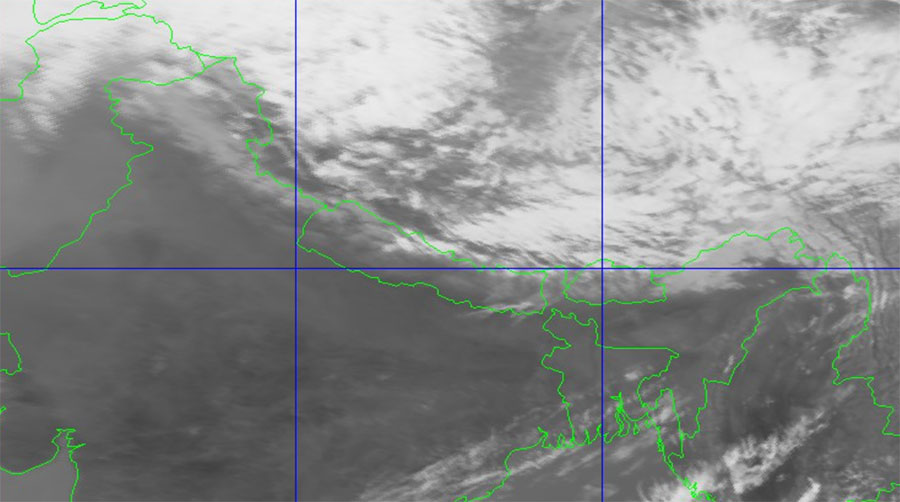
Kathmandu, June 3: Temperatures have increased sharply with rainfall becoming sporadic since the past few days.
According to the Department of Hydrology and Meteorology, average temperature, which was below 37 degrees two days ago, has increased to 41 degrees today.
Meteorologist Saroj Pudasaini said that the temperature is gradually increasing and there is a possibility of hotter days in the plains of Madhes, Koshi, Bagmati and Gandaki Provinces.
According to the temperature measurements received by the department tonight, the maximum temperature today reached 41 degrees in Bhairahawa.
Similarly, the highest temperature in Nepalgunj was 39.5 degrees and 38.2 degrees in Janakpur, 38.2 in Simara, 38.1 in Dhangadhi, 36.9 in Chandragadhi, 36.5 in Dharan and 36.1 degree Celsius in Biratnagar.
The temperature in Kathmandu, which had dropped to 25 degrees a few days ago, increased to 30.6 degrees today.
Currently, there is a partial effect of a low pressure system and local winds around the western region of Nepal.
Meanwhile, a bulletin published by the Department this evening, states that the weather in mountainous and hilly regions of the country would be generally cloudy and partially cloudy in the Tarai region. There is a possibility of moderate to heavy rain with thunder/lightning and snowfall in a few places in the mountainous and hilly regions of the country, including Lumbini and Sudurpaschim Provinces.
Furthermore, there is a possibility of a hot day in Madhes Province and in the plains of Koshi, Bagmati and Gandaki Provinces.
—
31- Sports contribute to strengthening mutual relations: President Paudel
Kathmandu, June 3: President Ramchandra Paudel has said that sports contributes significantly to strengthening mutual friendship, fraternity and relations, and to the spirit of national unity and expanding international relations.
Addressing the inaugural ceremony of the 16th President’s Running Shield Competition organized by the National Sports Council today, President Paudel said that sports in the present era are not limited to competition, profession, fame and identity. “It is a powerful means of all-round development of an individual. And it is also the foundation and basis of discipline, cooperation, leadership, confidence and national unity.”
Stating that sports have become an attractive profession and a means of enhancing the pride, prestige and glory of the nation, he said keeping in mind the special importance and characteristics of sports, the government should formulate special policies and programs to attract and encourage sports by increasing sports competitions, programs and activities right from the school level along with quality education.
As the craze for sports is growing in the country the state should give priority to it to assure that those involved it can see a future in sports. “Although winning and losing are natural aspects of sports, participation in sports competitions, continuous practice and effort, learning and experience are important achievements too,” the President said.
—