- Tuesday, 16 June 2026
Kathmandu, June 15: The Department of Livestock Services has said that around 700,000 fowls were culled in 10 districts following the recent confirmation of bird flu cases. The H5NI virus has been detected in 10 districts across the country, including the Kathmandu Valley.
Likewise, around 300,000 kilos of poultry feed were destroyed. The Department has mobilized a rapid response team to prevent the further spread of the virus, which has so far been confirmed in Kathmandu, Lalitpur, Bhaktapur, Jhapa, Morang, Sunsari, Mahottari, Bara, Chitwan, and Nawalparasai, said Director General Dr Umesh Dahal.
He said no vaccine against bird flu has been available as of now, and the culling of fowls and poultry products is the primary measure to control the virus spreading further.
Similarly, around 1.1 million eggs were destroyed following the virus outbreak that began a few weeks ago. The Department had pledged compensation to the affected farmers based on existing rules. The compensation will be ensured in coordination with the respective province governments, it is said.
—
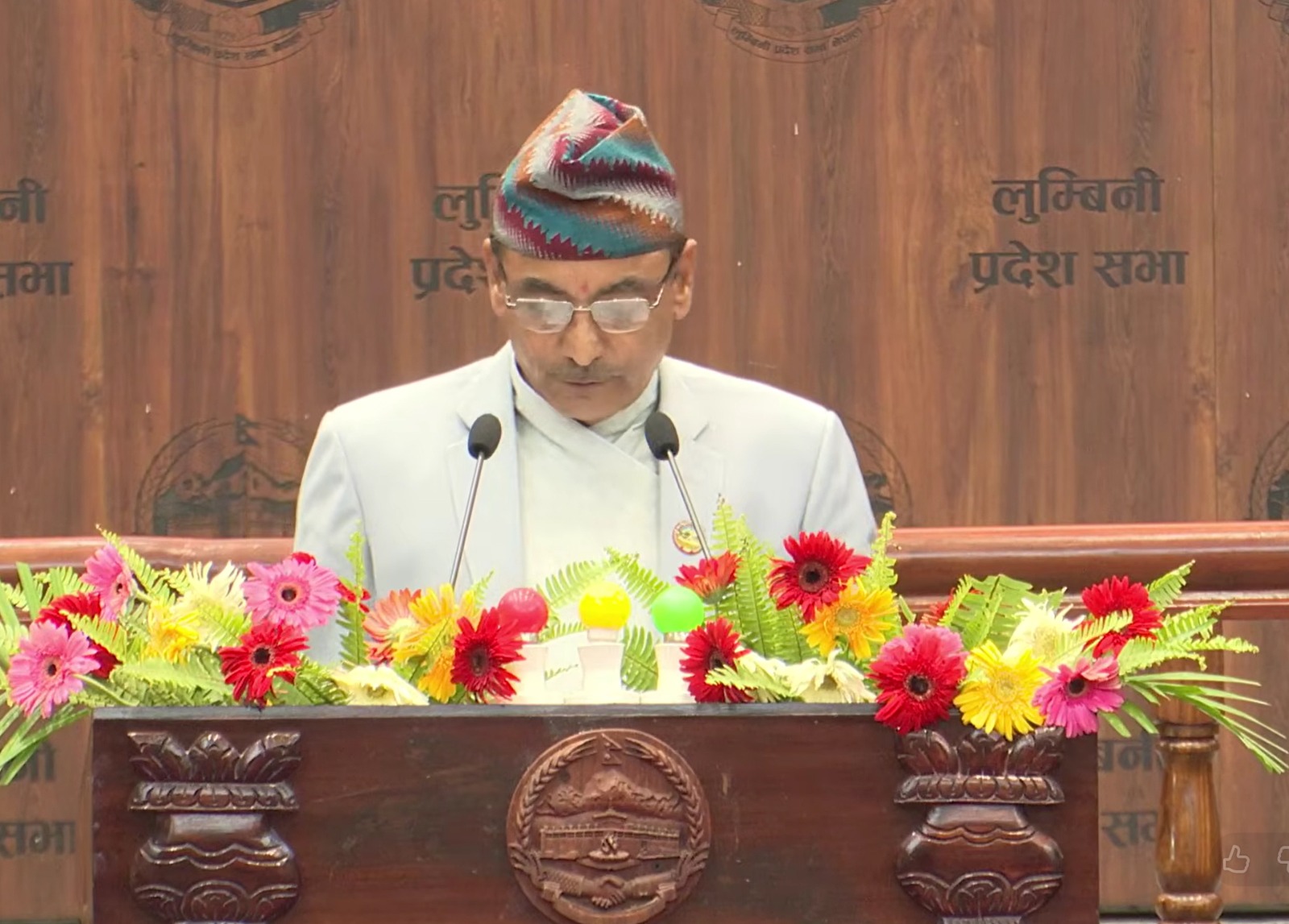
05- Lumbini Province government presenting budget today
Siddharthanagar (Bhairahawa), June 15: The Lumbini Province government will be unveiling its budget for the upcoming fiscal year 2083-84 BS (2026-27) today.
Province Minister for Economic Affairs and Planning, Dhanendra Karki, is scheduled to present the government’s estimates of revenue and expenditure for the upcoming fiscal in a meeting of the Province Assembly scheduled to take place at 5:00 pm today.
The province government had brought a budget of Rs 38.91 billion for the current fiscal year.
According to the government source, the upcoming budget aims to address the government’s long-term vision of “Prosperous Lumbini: Happy Citizens”, the second Periodic Plan, and the Sustainable Development Goals.
—
06- 2,025 cases of traffic rule violations recorded in 24 hours
Kathmandu, June 15: A total of 2,025 vehicles were tracked and fined over the past 24 hours for violating traffic rules. The Kathmandu Traffic Police Office said that revenue of Rs 1.048 million has been deposited into the state treasury.
The violations include 100 incidents of drunk-driving, 107 of ride- sharing against the rules, 136 of traffic signal violations, and 165 incidents of over-speeding, said Traffic Police Spokesperson and Superintendent of Police, Naresh Raj Subedi.
Likewise, 58 cases were recorded for breaching lane discipline, 109 for honking in prohibited areas, 105 for parking on roadsides, 117 for violating one-way traffic rules, and 1,128 other violations.
—
07- Sombarey Aunshi observed by taking silent bath, Adhika-masa concludes today
Kathmandu, June 15: The customary practice of silent bathing was observed today on Sombarey Aunshi, the new moon day that falls on a Monday.
As per the Vedic Sanatan Hindu tradition, on Sombarey Aunshi, devotees take a ritual bath early in the morning without speaking to anyone. This practice has been followed since ancient times.
It is believed that observing this ritual fulfills one’s wishes and brings blessings.
According to former member of the Nepal Panchanga Decision Committee (Nepal Calendar Fixation Committee), Prof Dr Devamani Bhattarai, Sombarey Aunshi usually occurs two to three times a year.
He said that religious scriptures mention that observing a silent bath on Sombarey Aunshi brings happiness in a conjugal life and auspicious outcomes in one’s life.
The day is also considered significant in performing other rituals: Shradhha and Tarpan in honour of ancestors.
Similarly, the month-long Adhika-masa (leap month) which had begun on May 17 is concluding today, as per the calendar determined by the committee. This period is observed by organising various religious fairs and events.
Adhika-masa also called the Adhik-mas, Mala-masa, and the Purushottama-masa, is an intercalated month in the Hindu calendar that is inserted to keep the lunar calendar aligned with the months of the year. The adhika-masa is an extra lunar month added to the solar calendar approximately every three years so that the lunar and the solar years are synchronised, along with the agricultural cycle and seasons.
—
08- Resunga Municipality feted with Netrajyoti Distinguished Honour
Kathmandu, June 15: The Resunga Municipality has bagged the Netrajyoti Distinguished Honour for making an outstanding contribution to eye care services to prevent blindness.
The municipality said that now all citizens in the municipality have access to eye treatment and no citizen should be deprived of treatment for cataracts due to financial difficulties.
At the 30th central convention of the Nepal Netrajyoti Sangh, the founders Prof. Dr. Ram Prasad Pokharel, Deputy Speaker of Koshi Provincial Assembly Sirjana Danuwar, and central president Prof. Dr. Chetraj Pant handed over the Letter of Honour to Resunga municipality mayor Khildhwaj Panthi.
On this occasion, Mayor Panthi shared that he decided from the first meeting of the municipal executive committee to make eye care services accessible to all citizens, saying that currently, no patient would be deprived of eye care services due to a lack of funds in the municipality.
According to him, the municipality has helped run dialysis services for kidney patients at Gulmi Hospital. Currently, 40 patients are benefiting from this service.
The municipality is also providing oxygen concentrators door to door for patients with asthma and pneumonia. It is reported that around 200 patients have benefited from this.
The Netrajyoti Sangh had also given that honour to Gorkha Municipality.
Philanthropist Sapkota honoured
On the same occasion, social worker Krishna Hari Sapkota from Gulmi was awarded the Netrajyoti Special Honour.
Sapkota built a two-and-a-half-storey building on one ropani of land in Musikot Municipality, Ward 7 and handed it over to the Nepal Netrajyoti Sangh Gulmi Branch. Its value is reported to be around Rs 25 million.
Currently, the building houses an eye treatment centre run by the Sangh.
—
09- Over 2,300 Gharial crocodiles released in various rivers in 45 years
Chitwan, June 15: Over the past 45 years, the Gharial Crocodile Breeding Centre in Chitwan National Park has successfully released 2,315 crocodiles into various rivers with the majority, 1,560, being released into the Rapti River.
In the current fiscal year alone, 225 crocodiles were released, comprising 14 males and 211 females. The centre has also reported releases in other rivers, including Narayani, Saptakoshi, and Karnali, among others.
Despite these efforts, the population of crocodiles in the wild has not shown a significant increase, with only 366 individuals counted in the Rapti and Narayani rivers last year.
The Gharial (Gavialisgangeticus) crocodile, classified as an endangered species, has seen a dramatic decline in its global population, from approximately 10,000 in the 1940s to just two percent of that number by 1970.
This decline has spurred conservation efforts, leading to the establishment of the breeding centre in 1975 when fewer than 100 Gharials remained in Nepal. Current threats to their survival include human activities, pollution, and the extraction of river resources, which compromise their natural habitat.
The breeding centre continues to play a crucial role in the conservation of this species, with 500 crocodiles currently housed there and ongoing breeding efforts yielding new hatchlings.
—
10- Raised embankment along bordering area by India heightens risk of inundation in Gaur
Chandrapur (Rautahat), June 15: An embankment constructed by the Indian side along the Nepal-India border near Gaur, district headquarters of Rautahat district and Bairagania in Bihar State of India has reportedly been raised higher and reinforced under the pretext of maintenance.
The development has led to heightened concerns over potential flood and inundation risks in southern Nepal.
Local residents reported that the work has been carried out unilaterally despite border regulations that prohibit either country from constructing, expanding or modifying physical structures on or near the no-man’s land (Dasgaja) without mutual agreement.
Also, cross-border norms require countries to consider the impacts of their infrastructure projects on neighbouring countries and to avoid actions that could cause flooding or environmental harm across the border.
Amit Keshari, a local resident, recalled that the embankment in the Bairgania area has long blocked the passage of floodwaters during the monsoon season, resulting in repeated inundation of Gaur municipality and dozens of surrounding villages in Nepal side.
He further shared that Indian side had previously constructed a 15-foot-high, five-kilometer-long embankment along the border to protect Bairgania and other parts of Bihar from flooding, but, he added, the structure has redirected floodwaters toward Nepal.
According to him, three sluice gates on the eastern section of the Bairagania embankment are routinely kept closed, preventing proper drainage and contributing to annual flooding in Gaur.
He also mentioned that personnel from India’s border security force, the Sashastra Seema Bal (SSB), maintain a constant presence at the embankment, reportedly to prevent any attempts to damage the structure or force the gates open during flood events.
Likewise, Gautam Shrestha, a resident of Gaur and Secretary of the Rautahat chapter of the Federation of Nepali Journalists, warned that the increased height of the embankment could further block the natural flow of water from the Lalbakaiya and Bagmati rivers.
As a result, he cautioned, water may back up into Nepali settlements, increasing the likelihood of inundation and severity of flooding.
Shrestha observed that additional soil has recently been added to the ring embankment in the Bairagania area, which, he worried, could further restrict monsoon floodwaters.
He voiced his concern that Gaur and nearby communities may face extensive inundation if water is unable to drain effectively.
—
11- Foreign Minister Khanal visits Chinese Academy of Sciences
Kathmandu, June 15: Minister for Foreign Affairs Shisir Khanal, who is on a four-day official visit to China, has visited the ‘Institute of Tibetan Plateau Research, Chinese Academy of Sciences’ this morning.
According to Nepali Embassy in Beijing, minister Khanal visited the research institute and emphasized the need for more intensive cooperation between the two countries.
The Foreign Minister is scheduled to hold bilateral talks with his Chinese counterpart in Beijing today at 5:45pm local time.
He had left for Beijing on Sunday morning at the invitation of the Chinese Foreign Minister Wang Yi.
Minister Khanal will return home on June 17 wrapping up his official trip.
—
12- Budget for next fiscal is reform-oriented, says Nepal Development Watch
Kathmandu, June 15: Nepal Development Watch (NEDEW) has said that the budget for the fiscal year 2083/84 brought by the government is more reform-oriented in terms of policy direction.
NEDEW has pointed out that the budget needs targeted interventions for marginalised communities along with economic growth goals. The organisation described the government’s plan to reduce the number of federal ministries from 22 to 18 and to abolish or merge 31 entities as clear steps towards good governance.
Even though the budget of Rs 212 billion is the largest in Nepal’s history, managing the financial gap, which is bigger than the expected revenue, will remain a challenge for the government, according to the institution.
NEDEW has stated that tax and economic reforms focused on the middle class, investors and the technology sector as positive signs. The organisation has also welcomed the increase in nutrition allowance for Dalit children, the expansion of nutrition programmes in highly impoverished districts, and some priorities in health and education.
However, NEDEW has pointed out the risk that the benefits of public investment may not reach all communities equally, noting targeted programmes for marginalised groups are necessary. The organisation suggests that the budget needs to be more effective in areas like job creation, export promotion and improving the investment environment.
—
13- HoR meeting: Opposition MPs demand govt’s response on national sovereignty issue
Kathmandu, June 15: Parliamentarians of opposition parties in today’s meeting of the House of Representatives (HoR) urged the government to take national sovereignty and border-related issues more seriously.
They also demanded clear explanations on several recent developments. As soon as the meeting commenced, they stood up from their seat in protest.
Speaker Dol Prasad Aryal thereafter allotted time to Padma Aryal, Deputy Leader of Parliamentary Party of the CPN (UML) to put forth her views.
Speaking in the meeting, Aryal sought clarification regarding remarks made by Foreign Minister Shisir Khanal during his recent visit to India.
She also expressed dissatisfaction with statements made by Finance Minister Dr Swarnim Wagle while responding to parliamentary queries.
Likewise, Harkaraj Rai, Chairperson of the Shram Sanskriti Party, pressed for the need to remove Prime Minister Balendra Shah’s statement on issues delivered in the HoR meeting on May 31 from the parliamentary record.
He also criticized a series of incidents across the country, including the destruction of SEE students’ mobile phones by submerging them in water, the pushing of a three-wheeler vehicle off a cliff and alleged police vandalism involving pelting of stone at a private residence dubbing these acts as ‘wrongdoing’.
It may be noted that Prime Minister Balendra Shah on May 31 had remarked about land usage along the Nepal-India border, saying, ‘in some places, land currently used and occupied by Nepal may fall on the Indian side while land currently under India’s use and occupation may lie on the Nepal’s side’ in parliament while responding to queries of the lawmakers.
Similarly, Yubaraj Dulal, Chief Whip of the Nepal Communist Party, demanded a government response regarding reports that an Indian Army helicopter had entered Nepal’s territory in Darchula district.
He also drew the government’s attention to concerns that a renowned tea industry in Ilam district is on the verge of closure.
Also, voicing concerns, Nepali Congress’s Renuka Kaucha called for making public the report prepared by a probe committee regarding the assets of Minister for Home Affairs Sudhan Gurung.
Bharat Giri, representing theRastriya Prajatantra Party (RPP), hailed the valour of and courage demonstrated by the citizens of Nepali in Susta, Nawalparashi, who confronted personnel from India’s border force- Sashastra Seema Bal (SSB)-personnel after they allegedly entered Nepal’s terrorist with weapons.
He also urged that the government be more sensitive to the concerns and security of Nepalis living in border areas.
—
14- HoR meeting: Deliberations on Appropriation Bill begin
Kathmandu, June 15: The House of Representatives (HoR) has commenced discussions on the Appropriation Bill for the fiscal year 2083 BS, focusing on the allocation of funds across nine ministries.
Key ministries under review include Youth, Labour and Employment, Industry, Commerce and Supply, Agriculture, Forestry and Environment, Information and Communication, Culture, Tourism and Civil Aviation, Education and Sports, Health and Food Hygiene, Land Management, Cooperatives, Federal Affairs and General Administration, and Women, Children, Gender and Sexual Minorities and Social Security.
Speaker Dol Prasad Aryal has not set a specific time limit for the discussions, allowing parliamentarians to present their proposals for budget cuts. Several MPs have proposed to reduce the budget allocation for various ministries to one rupee, highlighting their concerns over expenditure.
Finance Minister Dr Swarnim Wagle previously presented the annual budget estimates for revenue and expenditure during a joint meeting of the Federal Parliament on May 29.
The assembly has also completed a general discussion on the budget and the Minister of Finance’s responses.
Additionally, Speaker Aryal’s proposal to amend the membership of the thematic committee within the HoR was accepted by the assembly.
—